Science
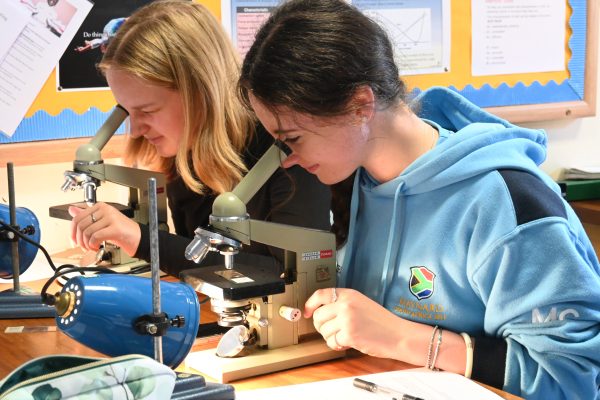
It’s absolutely no secret that women are still hugely underrepresented in STEM careers across the world, but here at The Maynard we continue to rewrite the narrative and to set new standards for female participation in science and technology. You only have to look at the statistics to see we really are bucking the national trend and leading the charge for women in STEM – an exciting place to be!
- Nationally, only 35% of females choose to study STEM subjects after GCSEs, and this figure plummets to just 25% at university.
- But here at The Maynard, we’re not just defying these statistics – we’re demolishing them.
- Nearly 60% of our Sixth Form students study at least one Science subject at A-level, with many choosing multiple.
- Equally, over 50% of our Year 13 leavers pursue STEM subjects at university, with a remarkable number opting for Engineering (where only 15% of graduates are female).
So, what’s our secret? It is a proven fact that being girls-only is instrumental in banishing any form of stereotyping which is often attributed to the demise of female participation in STEM subjects within the co-ed sector. Additionally, there is no doubt that the great majority of our success lies in our exceptional Science teaching and our incredibly passionate staff.
In Years 7 and 8, Biology, Chemistry and Physics are taught together in an exciting context-based curriculum which is a true celebration of the interdisciplinary nature of Science. Girls progress on to GCSEs in Science from Years 9 to 11. Pupils are given the choice of following the AQA Separate Science GCSE route, which culminates in separate GCSEs in each Science, or the AQA Combined Science Trilogy route, which culminates in two Science GCSEs.
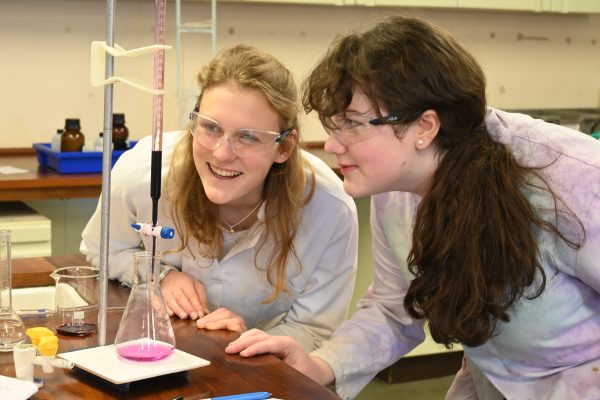
All Maynard pupils embark on AQA Science GCSEs in Year 9 and study Biology, Chemistry and Physics separately over a 3-year period. Students may study the Combined Science GCSE route or may choose Separate Sciences as one of their GCSE options. These are both exciting and challenging courses designed to make Science relevant to everyday life, whilst also offering academic rigour.
‘…standing on the shoulders of giants.’ Once said by Isaac Newton but also true of Science at Maynard. Building on many years of successful teaching, our A-level curriculum is exciting, challenging and innovative.
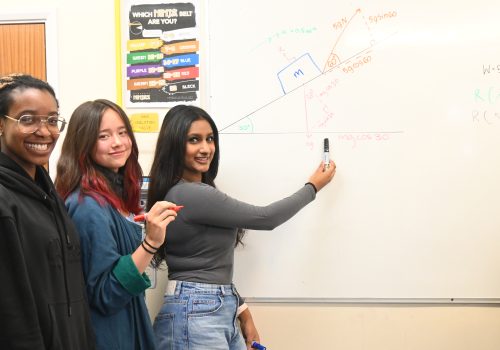
We offer Biology, Chemistry and Physics at A-level, following the Edexcel syllabus in Chemistry and Physics and the AQA syllabus in Biology. Our style of teaching aims to convey the excitement of contemporary Science by placing it in the context of its practical applications. Students find the courses academically challenging, but above all engaging.
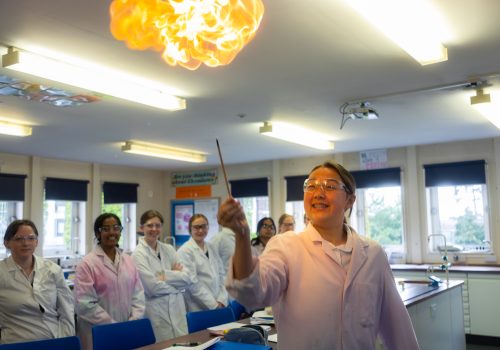
In the Science Department we encourage pupils to participate in a broad range of extra-curricular activities to develop their inquiring and analytical minds. In addition to these activities we regularly attend enriching events. For example, we have recently taken A-level science groups on a Biology trip to ‘We the Curious’, a Chemistry trip to the ‘Rothamsted Research Centre’ and a Physics trip to the Norman Lockyer Observatory. We also promote work experience and residential courses in STEM subjects via the Engineering Development Trust.
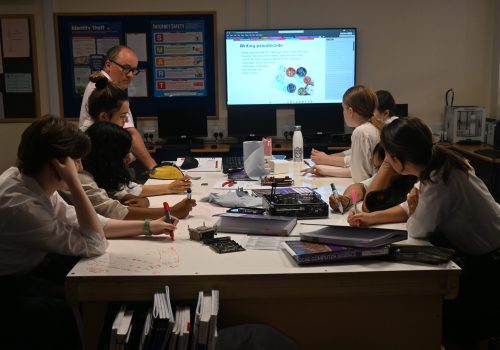
But our commitment goes beyond the classroom. Our dynamic extra-curricular programme ignites passion for STEM from the get-go. In Year 7, students join our STEM club, learning to solder, use CAD software and create 3D-printed keyrings. They build phone camera microscopes and launch air-powered rockets, making Science fun and tangible. They also attend a Science reading group, which is delivered by a team of outstanding Sixth Form scientists.
See the full list of extra-curricular activities…
For students in Years 7 to 11:
- Year 7 STEM Club
- Year 8 Chemistry Club
- Key Stage Three Science Reading Group
- Year 9 British Science Week House Competition
- LEGO Robotics Club
- YSTEMM Award Scheme
- Cityscape Architectural Design Competition
For students in Sixth Form:
- University aptitude test and interview preparation
- Olympiad competitions for Biology, Chemistry and Physics
- YSTEMM Award Scheme
- UK Space Design Competition
- Cityscape Architectural Design Competition
- Royal Society of Chemistry Schools Analyst Competition
- Ad Astra Chemistry Extension Club

Meet Ms York, Head of Biology
Ms York has a love of the life science which she developed whilst studying Natural Sciences at the University of Bath. She’s especially interested in human physiology and pharmacology, and enjoys showing students how what they learn in class links to real-life situations – whether that’s how the body responds to exercise, how medicines work, or how environmental challenges affect the natural world.
Read More
Her lessons focus on making Biology meaningful and engaging, helping students see its importance in the world around them. She’s passionate about helping students become curious, confident learners who can think critically about science and its role in everyday life.
Outside school, she enjoys yoga and learning more about health and wellbeing—something she often brings into her teaching. She’s always looking for ways to make biology exciting, relatable, and relevant, and hopes to inspire many students to follow their own scientific interests.
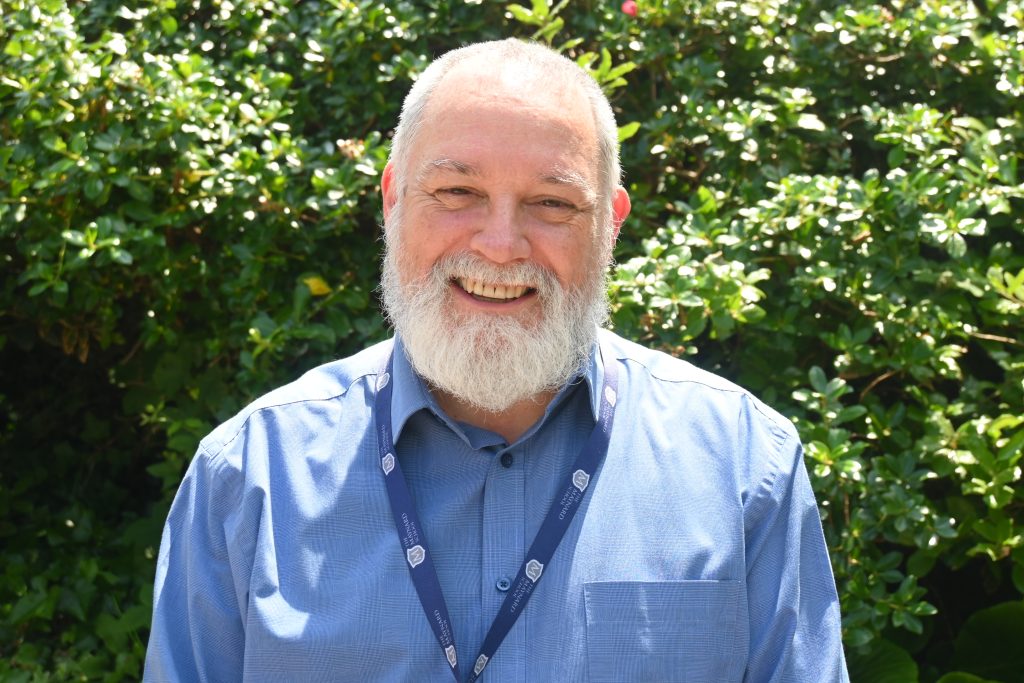
Meet Mr Macdonald, Head of Chemistry
I have always been curious about the world, and Chemistry offered the fastest route to understanding it – while also letting me create colourful reactions and the occasional explosion.
I was inspired by the Nobel Prize-winning Professor Sir Harry Kroto, whose visionary lectures opened up exciting possibilities in nanotechnology and beyond. After university, I worked across the UK, Europe, and the Middle East in the chemical industry. My chief role became problem solving technical issues and training people to work with our various products and systems. Tired of living in airports and hotels, I then changed careers.
Read More
In 1999, I gained my PGCE at the University of Exeter and then joined The Maynard as my second teaching job. Previously I had never stayed in a job for more than three years. I’ve now been here for over twenty—and I still find it vibrant, enthusiastic and full of promise.
What I love most about Chemistry is its power to explain the world at the most fundamental level—from the patterns in the periodic table to the reactions that power life. What I love about teaching at The Maynard is the lovely staff, and the constant delight of teaching Chemistry to enthusiastic students. It really feels like a team effort with everyone going in the same direction. Watson, the therapy dog, loves coming to school as well!

Meet Mr Ridler, Head of Science & Head of Physics
Mr Ridler’s passion for Physics stems from how it helps us to understand the workings of the universe, from subatomic particles to entire galaxies, as well as how it is applied by Engineers to design new technologies. He finds teaching Physics an exciting challenge that is hugely rewarding, and working with students at The Maynard School for many years has helped him to develop into a teacher who can stretch our most able learners as well as supporting students with complex ideas.
Read More
In particular, Mr Ridler is proud of being part of a Science Department that promotes and supports girls into STEM careers. Over the years, the science staff have constructed a comprehensive programme of extra-curricular clubs and events for students at all Key Stages which promote STEM careers to our young women; and with 50% of our Upper Sixth leavers choosing to study STEM subjects at university, this provision is clearly making an impact.
Outside school, Mr Ridler is a keen runner. On a good day he is competitive in anything from 5 km to ultramarathons. However, most days he is happy if he can keep up with his wife and two daughters!
Where next?