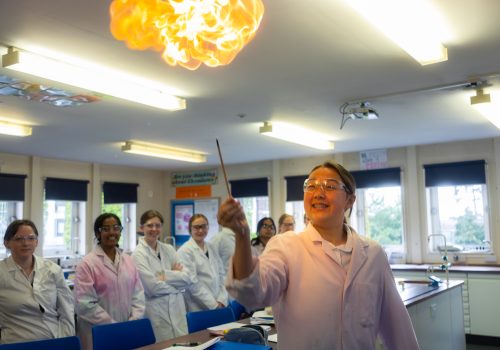
Curriculum

We are proud to be able to tailor our curriculum specifically for girls, based on hundreds of years of experience, and to offer such a vast array of opportunities away from the classroom. As the Good Schools Guide notes; girls are engaged with their learning, full of infectious enthusiasm for life, keen to reach their potential in everything they do, but are not highly strung, pushed or that much dreaded, much-used accusation “hothoused” in any way.
Pre-Prep – Reception and Key Stage 1
In the Pre-Prep we provide our pupils with a varied and interesting learning environment and offer a carefully balanced curriculum. Areas of learning focus on Literacy/Phonics; Numeracy; Personal, Social and Emotional Development; Communication & Language; Physical Development; Understanding the World; and Expressive Arts & Design.
There are specialist areas to enable creative learning and an outside classroom giving plenty of scope for all-weather outside learning and play. We have specialist teaching for PE, Music and Spanish.
Click on the buttons below to find out more about the curriculum for each year.

Junior – Key Stage 2

The Junior School provides a happy academic experience that also includes rigour and challenge. There is easy access to all the Senior School facilities and ready interaction between the older and younger pupils, culminating in a transition year in Year 6, when they enjoy full Senior School status as well as having significantly more lessons taught by specialist teachers in specialist classrooms.
Click on the buttons below to find out more about the curriculum for each year.
Senior – Key Stage 3
Our Senior classes enjoy a plethora of different subjects. We are very proud to be the only school in the area to offer Textiles and Food & Nutrition, both of which are absolute highlights for many of our students and offer important life-skills to take with them in the future. It is in the Senior School where girls find their niche, coming into their own with the unerring support of passionate teachers and lovely peers, ultimately feeling ready when the time comes to make the leap into GCSEs.
Click below to see the full range of subjects taught in Year 7-9, or view all departments here.
Subjects taught in Years 7-9
| Art & Design | Food & Nutrition | Music |
| Classics | Geography | Physical Education |
| Computing | History | Religious Studies |
| Drama & Theatre Studies | Mathematics | Science |
| English | Modern Foreign Languages | Textiles |

GCSEs
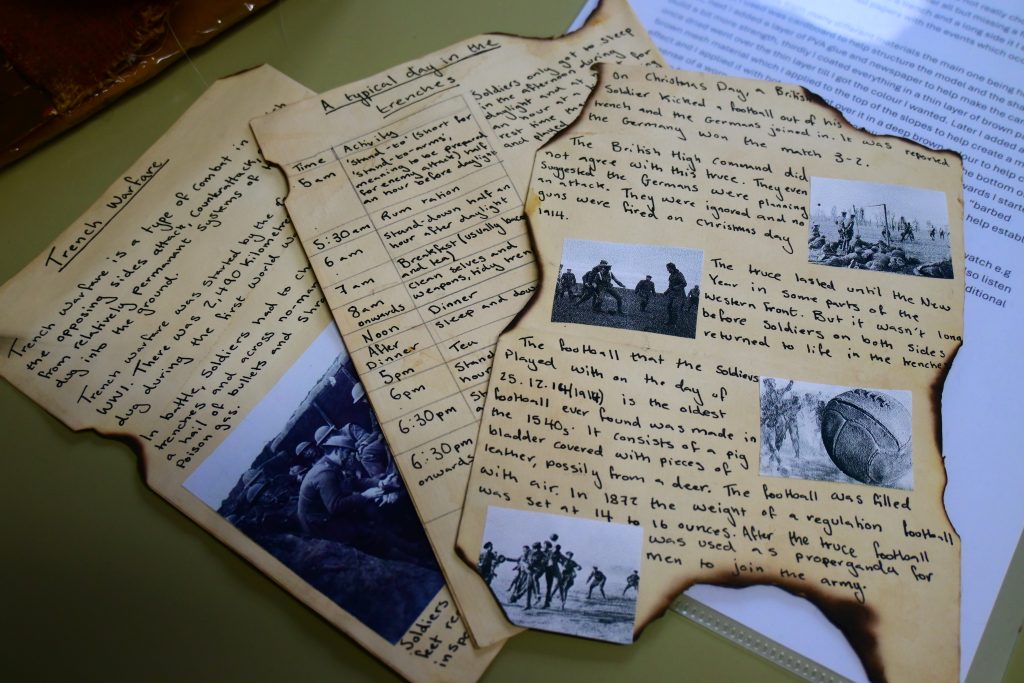
We offer a broad range of GCSE subjects with a wide choice of combinations in a friendly, encouraging environment. The GCSE curriculum is designed to challenge and develop students as they work to achieve their individual goals, supported along the way by brilliant teachers and award-winning pastoral care. Students will study for 9 qualifications: 5 core GCSE subjects and 4 options.
Core GCSE and general subjects:
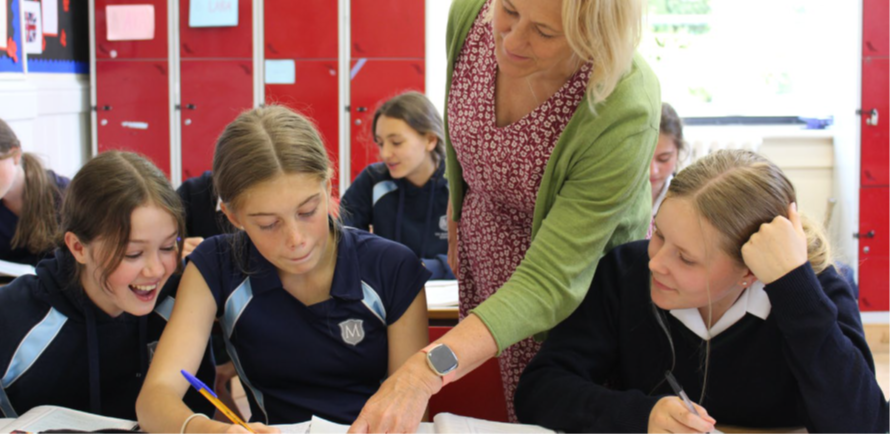
Awarding Body: Cambridge (English Language); Edexcel (English Literature) International GCSEs.
Specification: English Language 0990 & English Literature 4ET1
English Language and English Literature are examined as separate subjects, and our students will gain an IGCSE from each of them. Both subjects are taught simultaneously throughout the Lower and Upper 5. In the English Language course, 50% of assessment is through NEA (coursework), whilst in the English Literature course, 40% of assessment is through NEA work; both will be graded according to the 1-9 system.
Lessons are varied and stimulating and consist of debate and discussion as well as both analytical and creative reading and writing. For English Literature, pupils work towards one examination which covers a poetry collection set by the board and a modern prose text. The NEA work for Literature encompasses Modern Drama and a Literary Heritage text. For the English Language course, pupils are encouraged to produce accurate descriptive, narrative and transactional written work and to respond to a range of fiction and nonf iction texts taken from nineteenth, twentieth and twenty-first century sources. Assessment of spelling, punctuation and grammar contributes to both English Language and Literature.
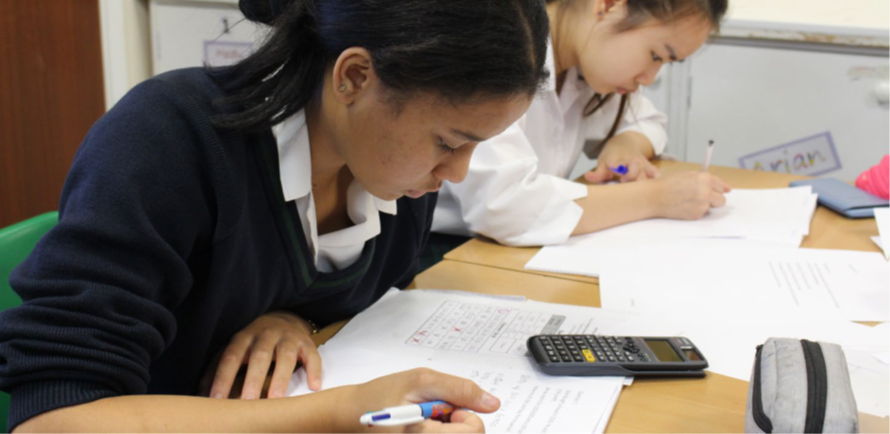
Awarding Body: Edexcel
Specification: GCSE (9-1) in Mathematics 1MA1
The course aims to enable students to:
• Develop fluent knowledge, skills and understanding of mathematical methods and concepts.
• Acquire, select and apply mathematical techniques to solve problems.
• Reason mathematically, make deductions and inferences and draw conclusions.
• Comprehend, interpret and communicate mathematical information in a variety of forms appropriate to the information and context.
Topics covered include all aspects of numerical calculation, algebra, geometry, trigonometry, data handling and applications of Mathematics.
The purposes of this qualification are to:
• Provide evidence of students’ achievements against demanding and fulfilling content, to give students confidence in the mathematical skills, knowledge and understanding that they will have acquired during the course of their study.
• Provide a strong foundation for further academic and vocational study and for employment and to give students the appropriate mathematical skills, knowledge and understanding to help them progress to a full range of courses in further and higher education. These courses include Level 3 Mathematics as well as Level 3 and undergraduate courses in other disciplines such as Biology, Geography and Psychology, where the understanding and application of Mathematics is crucial.
Awarding Body: AQA
Specifications: 8461, 8462, 8463 (Separate Science) and 8486 (Combined Science)
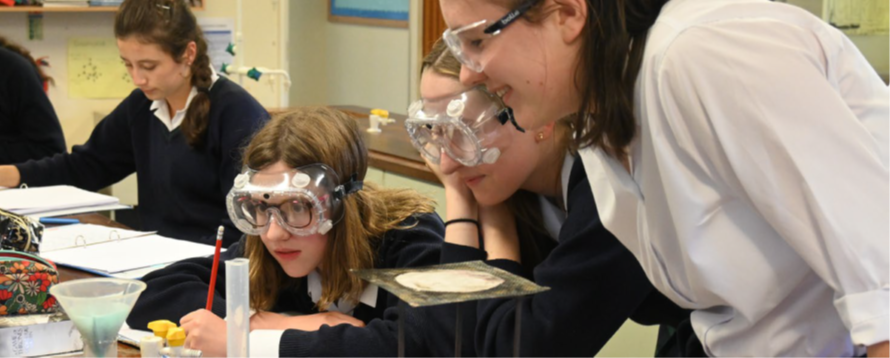
All Maynard pupils embark on AQA Science GCSEs in Upper 4 and study Biology, Chemistry and Physics separately over a 3-year period (Upper 4/ Lower 5/Upper 5). Students may study the Combined Science GCSE route or may choose Separate Sciences as one of their GCSE options. These are both exciting and challenging courses designed to make Science relevant to everyday life, whilst also offering academic rigour.
For pupils who choose the GCSE Separate Science route, each of the three separate Science GCSEs will be graded using the 9-1 system and will consist of two written examined units at the end of the Upper 5 year. We believe this route provides the best preparation for moving on to A-level Science, should students choose to do so.
Pupils who follow the GCSE Combined Science route still study Biology, Chemistry and Physics separately, however less content is delivered in each Science subject. Pupils following this route sit two shorter written examinations in each Science subject at the end of the Upper 5 year. The marks in the examinations for the three Science subjects are then combined and two Science GCSEs, graded using the 9-1 system, are awarded based on the total number of marks achieved in the three Science subjects. The Combined Science route is still appropriate preparation for A-level Science.
There is no longer a practical controlled assessment within Science. However, pupils will conduct a number of Required Practical Activities in each Science subject, the details of which can be assessed in the written examinations.
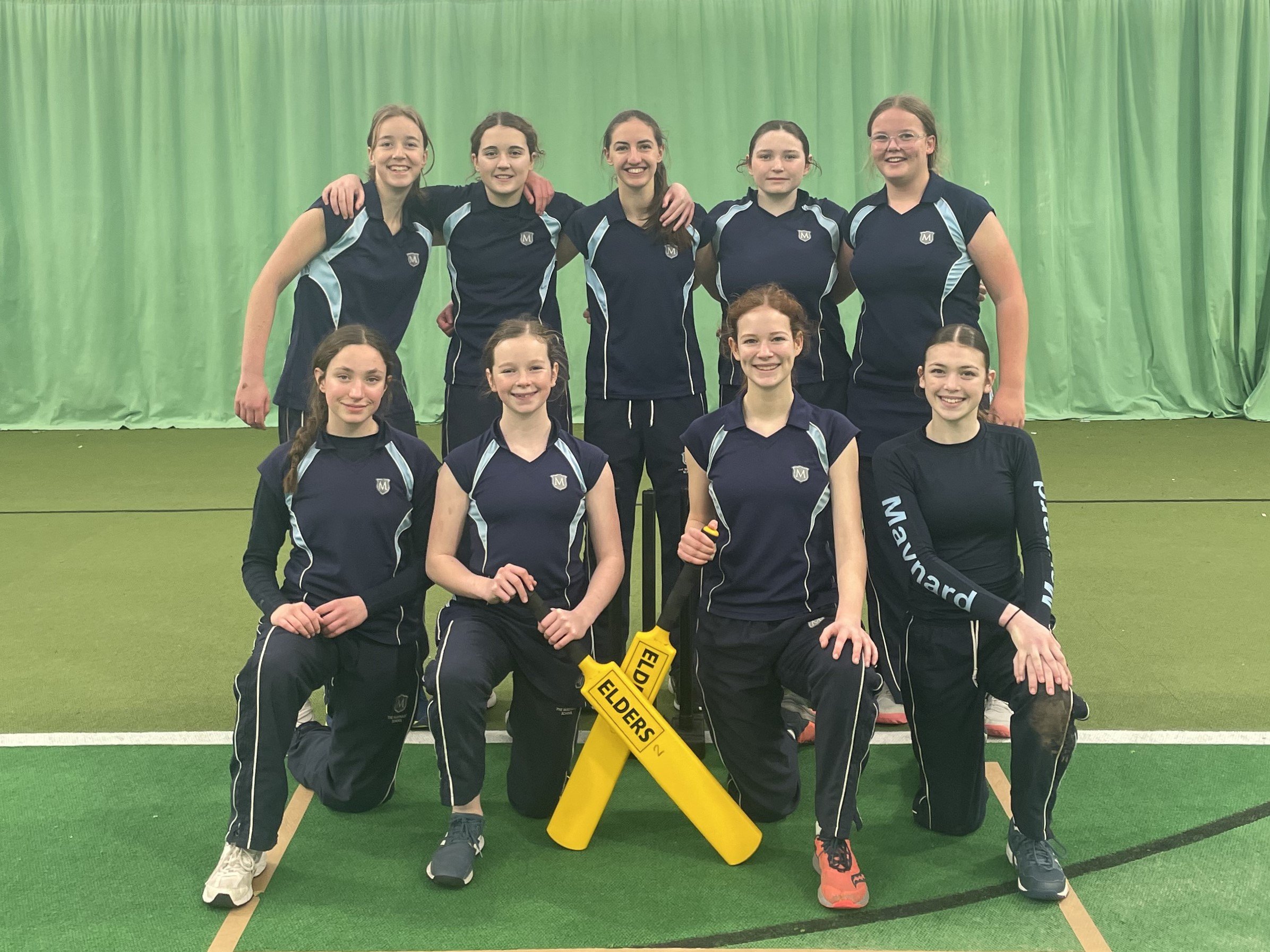
The emphasis is on encouraging girls to take more responsibility for their own fitness and build good habits for life-long participation in sport.
Lower 5 Programme: Two 1-hour lessons per week
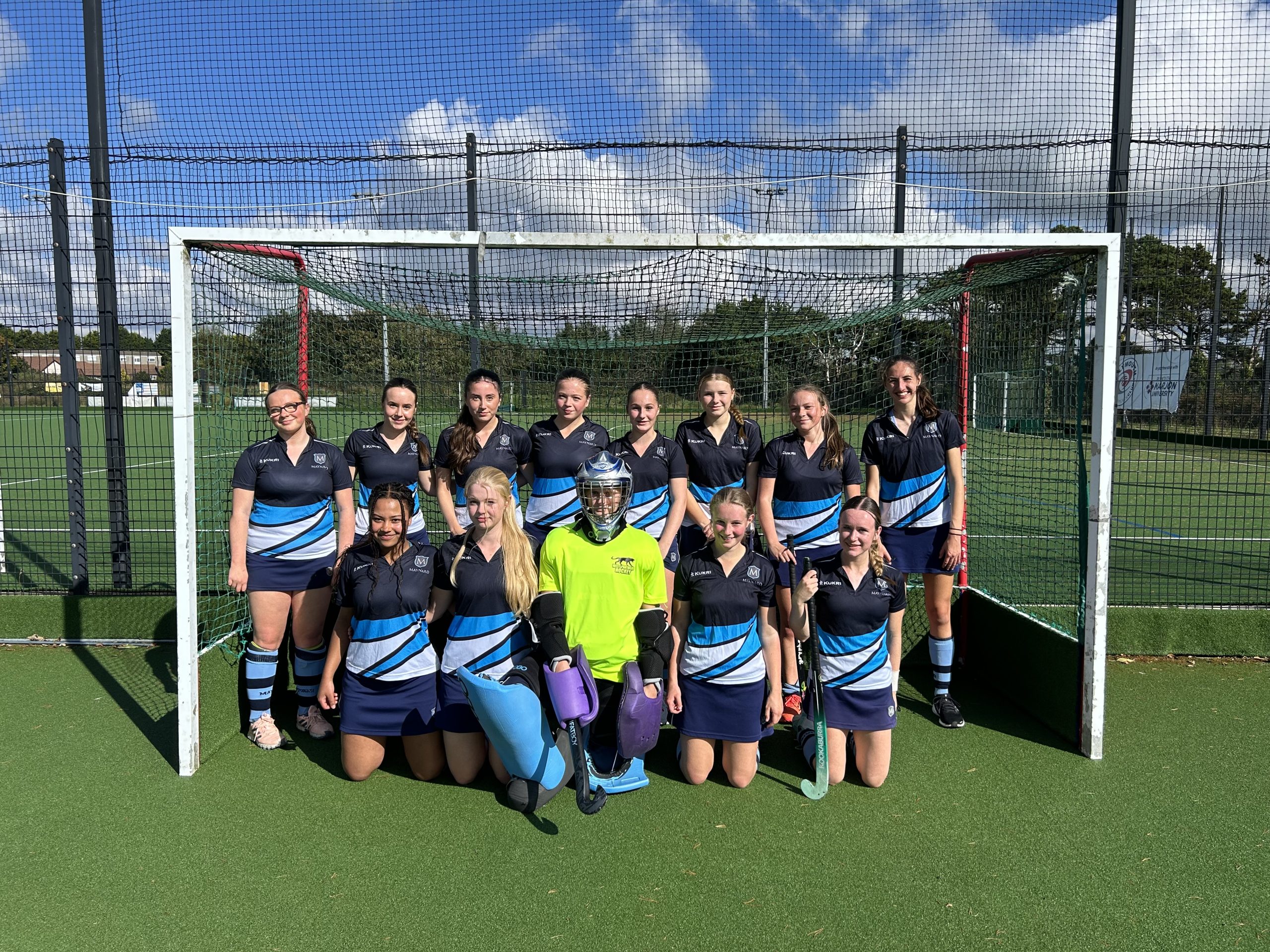
In the autumn term the Games curriculum includes basketball, fitness and hockey, whilst in the Physical Education lessons we cover netball, badminton, tag-rugby and volleyball, to name a few. During this term the Under 15 squad train for and play hockey fixtures.
In the spring term, during Games lessons, girls are introduced to a taster session system where they get to try activities that are options in Upper 5. In Physical Education we cover volleyball and Fitness for Life. Leadership opportunities are offered. During this term the Under 15 squad train for a play netball fixtures.
In the summer term the programme includes tennis, athletics, and rounders.
Upper 5 Programme: One 2-hour lesson per week
We offer an options system which encourages girls to choose according to their interest. We also provide opportunities to follow the Sports Leaders Award.
In the autumn and spring terms option are chosen from a range of different activities. The Under 16 and Senior squads play hockey in the autumn term and netball in the spring term.
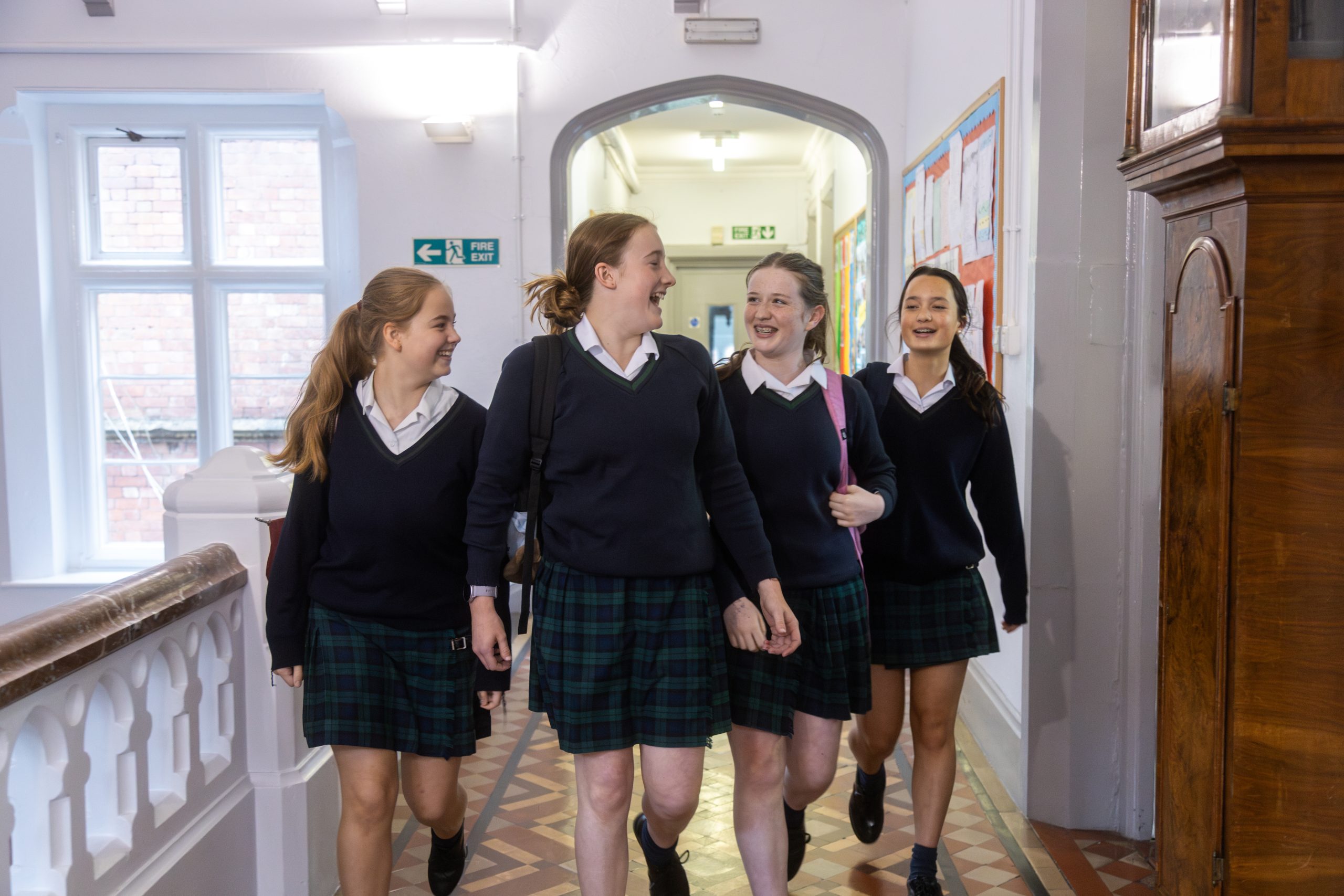
At The Maynard, PSHE education is viewed as an important and necessary part of our pupils’ education. In Years 10 and 11, our expert teachers deliver a planned programme of learning based on the National Curriculum through which our students acquire the knowledge, understanding and skills they need to manage their lives, now and in the future. As part of our whole-school approach, we aim to develop the qualities and attributes pupils need to thrive as individuals, family members and members of society.
Our students are taught to apply the knowledge and understanding they learn to practical, real-life situations and enable them to feel safe and secure enough to fill their academic potential.
Topics taught include drug education, financial education, internet safety, mental wellbeing, sex and relationship education (SRE) and the importance of physical activity and diet for a healthy lifestyle. Relationships and sex education (RSE) is compulsory for all secondary school pupils.
The aim of RSE is to give our young people the information they need to help them develop healthy, nurturing relationships of all kinds and to know what a healthy relationship looks like; what makes a good friend, a good colleague and a successful marriage or other type of committed relationship. We help pupils to understand the positive effects that good relationships have on their mental wellbeing, and to identify when relationships are not right and understand how such situations can be managed. Pupils are taught the facts and the law about sex, sexuality, sexual health and gender identity in an age-appropriate and inclusive way.
Pupils complete a number of different and varied activities in PSHE lessons including class discussion, written tasks, group work and role play. Work is assessed through: self-reflection, oral feedback and teacher assessment and is included in our school reports.
GCSE option subjects:
Awarding Body: OCR, Specification: J171
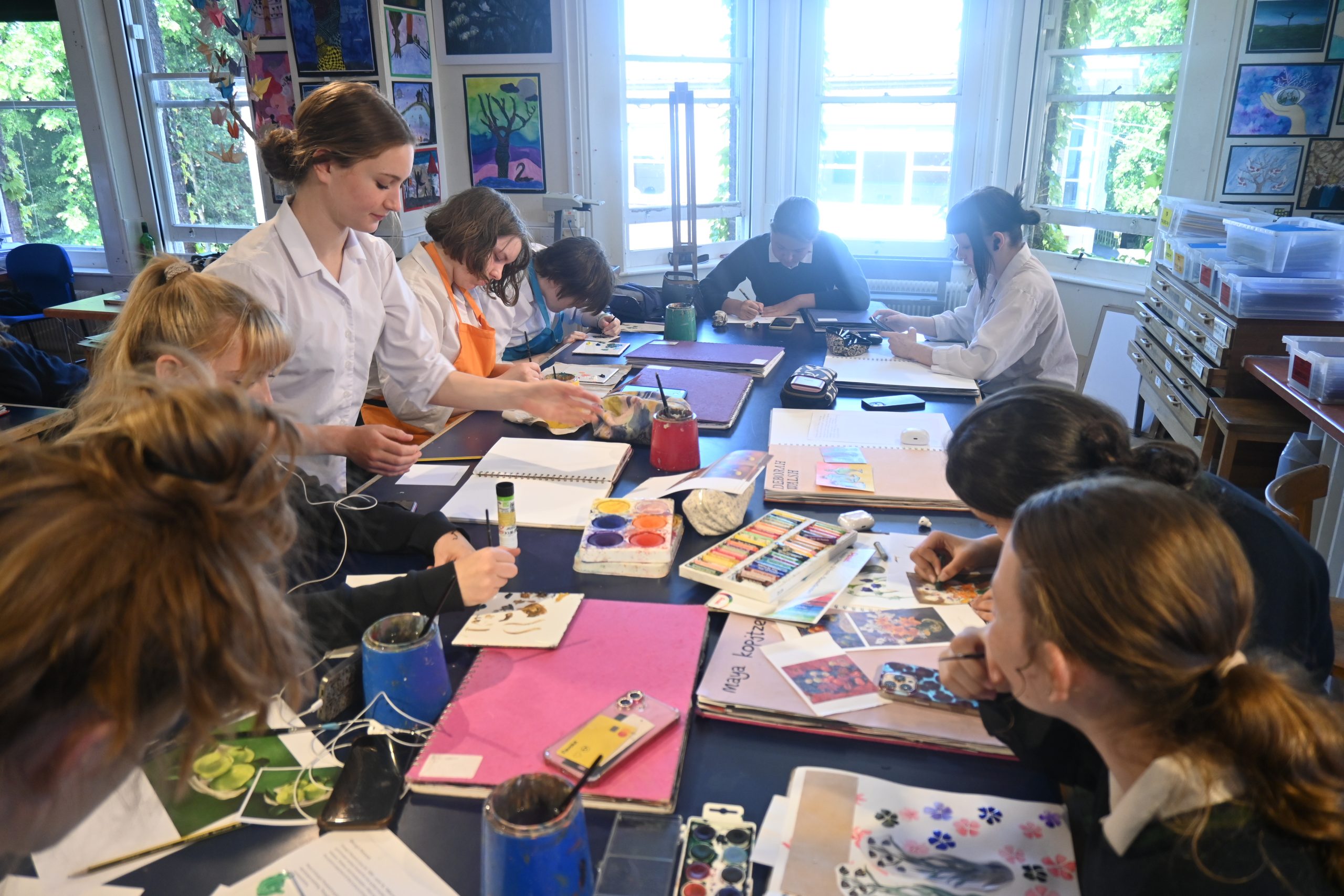
This exciting and enjoyable practical course develops students’ creativity and visual literacy. It encourages an enquiring approach, develops practical as well as analytical and communication skills. Students will develop as effective and independent learners, and as critical and reflective thinkers with enquiring minds. During the course, students will visit galleries and take part in a whole day Artist in Residence workshop. The achievements of all students are celebrated in the group Art Exhibition held at the end of the course.
Studying Art & Design will develop the valuable visual and practical skills which are valued in many careers from Architecture and Design Engineering to Medicine.
All coursework for submission is produced in school during Art & Design lessons and homework tasks. The course consists of:
Unit 1: Art and Design Portfolio (coursework, 60%).
Students will produce a portfolio of work that demonstrates a personal response to the subjects and themes set. A variety of 2D and 3D media is explored, and pupils are encouraged to always discuss their work with their teacher.
Unit 2: Art and Design Externally Set Task (examination, 40%).
For this unit students will receive an early release question paper from which they will research, plan, and develop their chosen starting point for their own personal response. They will be able to discuss their ideas and approach with their teacher. Up to 10 hours are given to complete the final piece.

Awarding Body: OCR, Specification: J277
Computer Science is an exciting, hands-on subject where you will not only learn but also apply skills to real-world challenges. Whether you’re intrigued by technology, enjoy problem-solving, or want to explore your creativity, this subject offers it all. It’s designed to inspire the next generation of innovators and problem-solvers, helping you gain essential skills for the future.
OCR has created this forward-thinking, relevant qualification in collaboration with industry giants like Microsoft, Google, and Cisco, as well as educational organisations like Computing at School (CAS), teachers, and academic experts. This ensures the course is not only engaging but also prepares you for the rapidly changing world of technology.
What will you learn?
Computer Systems Component
• In this part of the course, you’ll explore the fascinating world of hardware, software, and networks:
• How processors work: Get inside the ‘brains’ of a computer and see how instructions are executed.
• Memory and storage: Discover how computers store and access data quickly and efficiently.
• Modern network layouts: Explore how networks like the internet are structured and how they communicate across the globe.
• Cybersecurity skills: Learn how to protect systems from hackers and keep data safe—one of the most important skills in the digital age.
• Software in action: Understand the role different types of software play within computer systems.
• Ethical, legal, and environmental impacts: Explore the broader issues around technology—how it impacts our lives, culture, and the planet.
Computational Thinking, Algorithms, and Programming Component
• This component takes you deep into the world of programming, algorithms, and data:
• Algorithms in action: Study the fundamental algorithms that drive the software we use every day.
• Programming techniques: Build solid programming skills to design your own programs from scratch.
• Program design with diagrams: Visualise how your code works by creating diagrams to represent program flow.
• Testing and robustness: Ensure your programs are resistant to errors and misuse, making them reliable and secure.
• Boolean algebra: Master the logic behind computers with the essential building blocks of digital systems: AND, OR, and NOT.
• Data in binary form: Understand how computers store everything—from text to images—in binary code.
Why study Computer Science?
Computer Science isn’t just about computers—it’s about creativity, problem-solving, and innovation. Whether you dream of designing video games, building websites, creating apps, or developing the next big tech breakthrough, this course is your first step. You’ll develop skills in critical thinking, collaboration, and communication, all of which are in high demand in today’s digital world. Plus, you’ll be joining a growing movement of women in technology, where your contributions will help shape the future.
The technology industry is evolving rapidly, and there is a huge demand for skilled women to enter the field. By studying Computer Science, you’ll have the opportunity to work in exciting areas such as artificial intelligence, cybersecurity, game development, and beyond.
Be a part of the future of technology. Start your journey in Computer Science today.
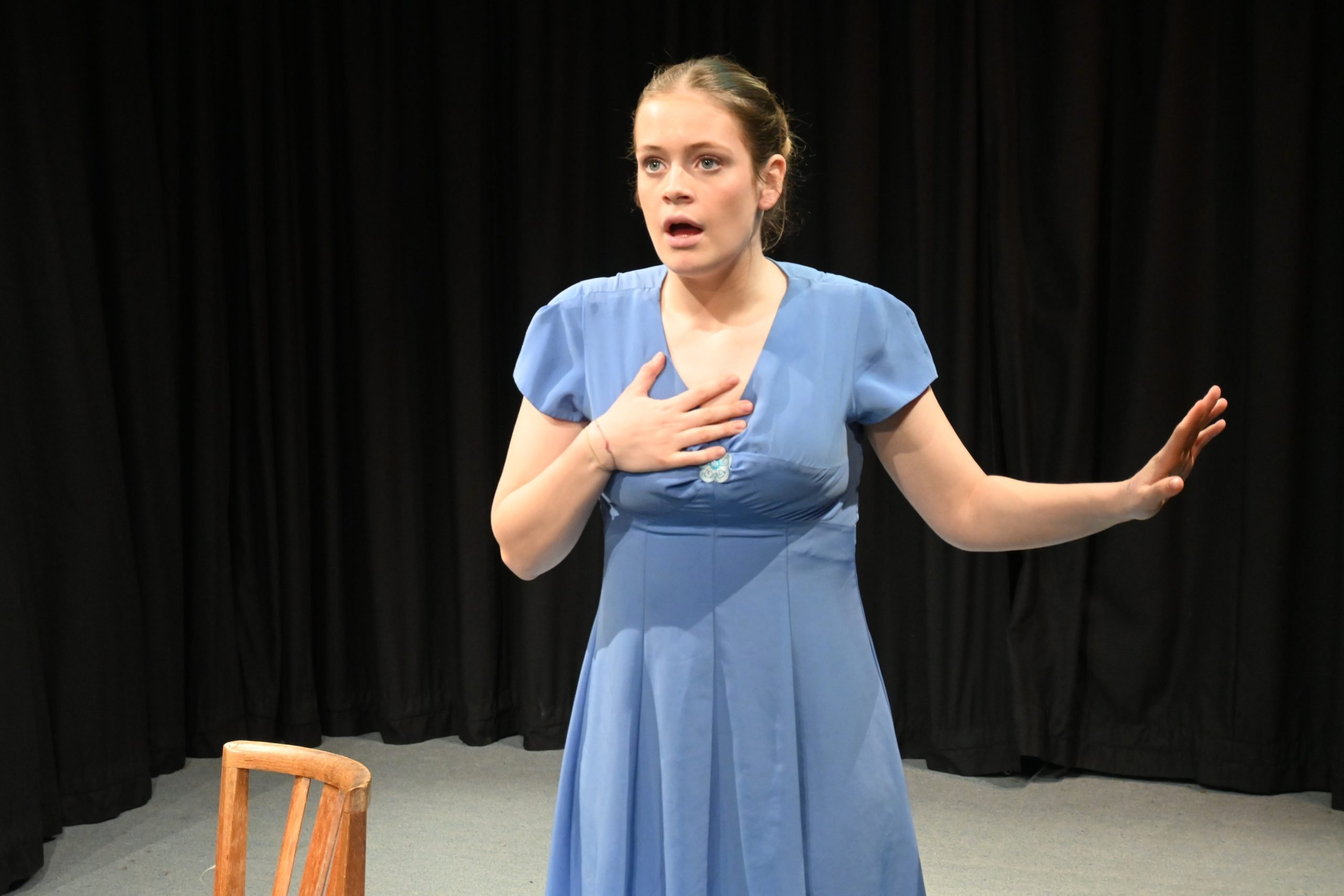
Awarding Body: Edexcel, Specification: 1DR0
GCSE Drama challenges students to work both creatively and intellectually whilst also furnishing them with valuable communication skills such as interpreting and communicating meaning to an audience, confidently voicing opinion and constructing persuasive argument. Students will also experiment with different ways of visually presenting ideas, whilst encouraging quick and lateral thinking.
Over the two years students will develop skills in creating their own devised work for performance. They will analyse play texts practically with a focus on staging and work as performers, directors and designers. We watch and review a range of professional theatre productions and attend workshops with professional companies. This is a well-respected qualification in which no two lessons are the same and where pupils are encouraged to think outside of the box.
Assessment is as follows:
Component 1 (40%) Devising:
Creation of a devised drama piece in response to stimulus materials (selected in-house).
Students are required to:
• Work within a given time frame
• Use a range of theatrical techniques to achieve a collective aim
• Shape and craft their work ready for performance to an audience
• Keep dedicated notes on their process and create portfolio style written coursework
• Learn to analyse and evaluate their own work and the work of others Individual Practical internal assessment, Written coursework element.
Performer and designer routes available.
Component 2 (20%) Performance From Text:
External examination by a visiting examiner of a combination of group/solo/ duologue performances of two extracts from a play text. Individual practical external assessment.
Performer and designer routes available.
Component 3 (40%) Theatre Makers in Practice:
There are two areas of focus in this written paper; analysis and evaluation of a seen live performance and performing, directing and designing for a set text. Watching a range of live theatre will be required for this element and is a highlight of studying this course. Written examination.
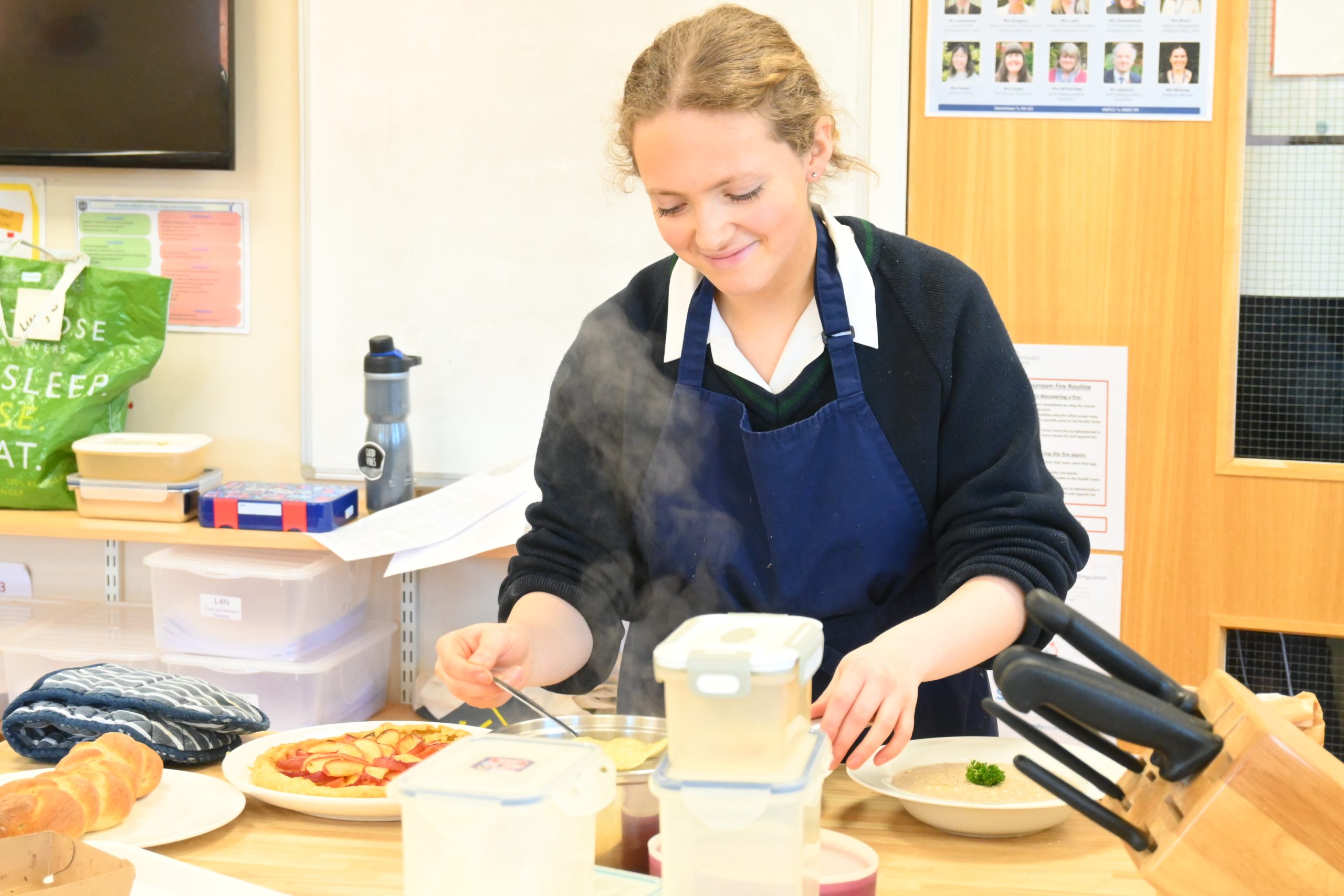
Awarding Body: AQA
This is an exciting GCSE course from AQA with a very strong practical element on a weekly basis, enabling students to investigate a wide variety of nutritional and health issues. During the course we build upon the work we have completed in Upper 4 and investigate the relationship between nutrition,food choice, diet and health. We aim to equip students with a range of life skills including organisation, management and practical skills, problem solving and decision making, all in the context of a relaxed and fun environment.
This course has the added bonus of having a Non-Exam Assessment known as an NEA which accounts for 50% of the total mark.
Subject content:
1. Food, nutrition and health
2. Food science
3. Food safety
4. Food choice
5. Food provenance
Food preparation skills are integrated into the five sections.
Paper 1: Food preparation and nutrition (50% of GCSE)
Theoretical knowledge of food preparation and nutrition from sections 1-5 Written exam: 1 hour 45 minutes, 100 marks.
Non-exam assessment (NEA) (50% of GCSE)
Task 1: Food investigation
Students’ understanding of the working characteristics, functional and chemical properties of ingredients.
Practical investigations are a compulsory element of this NEA task.
Task 2: Food preparation assessment
Students’ knowledge, skills and understanding on relation to the planning, preparation, cooking, presentation of food and application of nutrition related to the chosen task.
Students will prepare, cook and present a final menu of three dishes within a single period of no more than three hours, planning in advance how this will be achieved.
How is it assessed?
Task 1: written or electronic report (1,500-2,000 words) including photographic evidence of the practical investigation.
Task 2: written or electronic portfolio including photographic evidence. Photographic evidence of the three final dishes must be included.
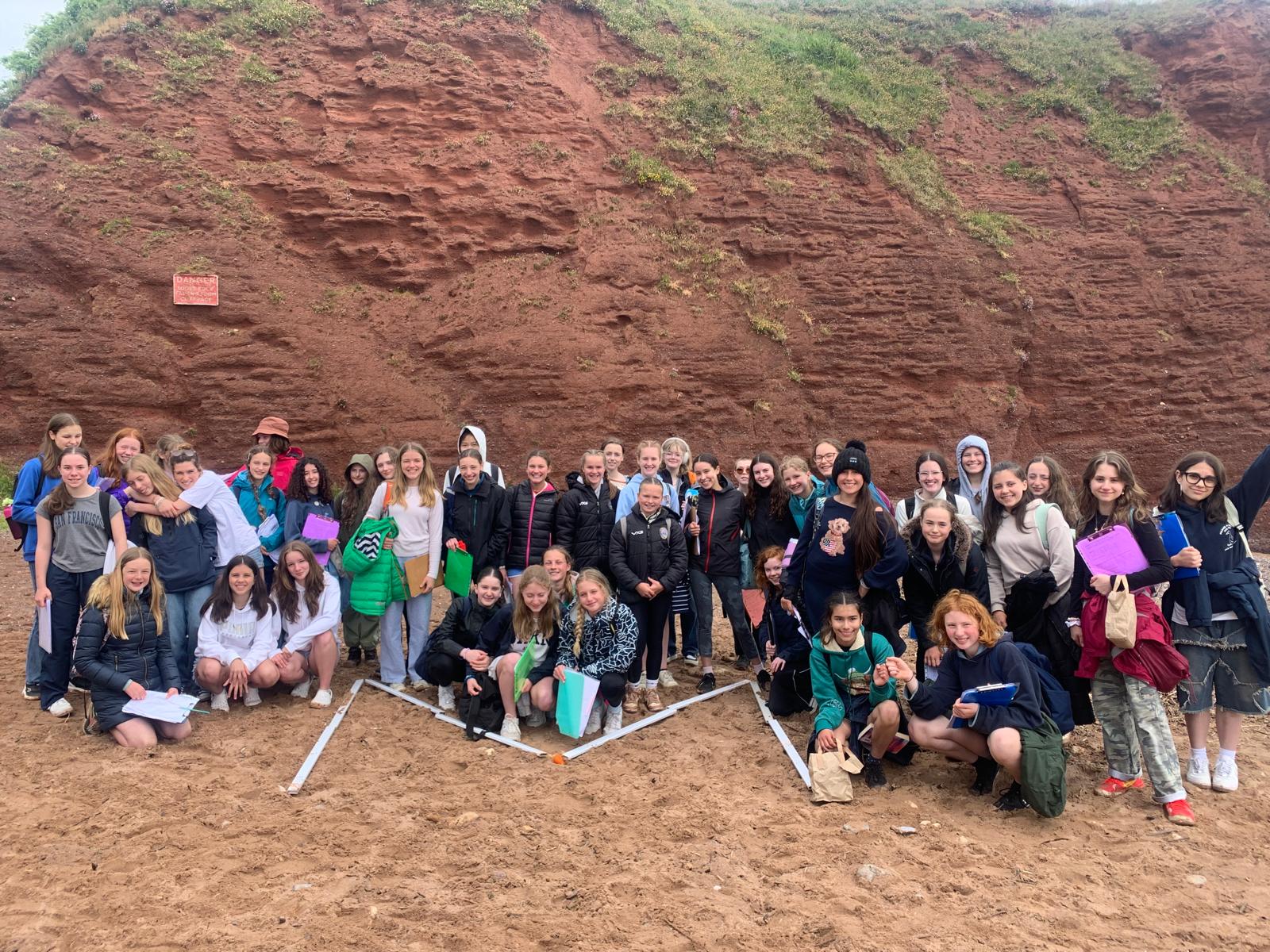
Awarding Body: AQA
The GCSE syllabus covers some of the most important global issues facing the planet today. Geography provides a global perspective to GCSE studies and helps students develop the knowledge, skills and understanding needed to deal with the issues which will affect them throughout their life.
There are six main topics (three Physical Geography, three Human Geography), plus an examination of two pieces of fieldwork and an issues evaluation.
Unit 1: Living with the Physical World: 1 hour 30 minutes (35%)
• Challenges of Natural Hazards: Tectonic hazards (volcanoes and earthquakes), tropical storms, extreme weather in the UK and climate change.
• Physical Landscapes in the UK: Coasts and rivers.
• The Living World: Local ecosystems, tropical rainforests and cold environments.
Unit 2: Challenges in the Human Environment: 1 hour 30 minutes (35%)
• Urban Challenges: Global patterns in two contrasting cities and sustainable urban futures.
• The Changing Economic World: Global patterns, closing the development gap, contrasting studies of economic development.
• The Challenge of Resource Management: Overview of resources in the UK, global resources and food security.
Unit 3: Geographical Applications: 1 hour 15 minutes (approximately 30%)
• Issue Evaluation: Theme of an issue which can be selected from any part of the specification based on secondary material in a pre-release booklet.
• Fieldwork: two fieldwork enquiries of physical and human environments. The fieldwork enquiry process is assessed through examination.
Geography helps to develop a wide range of skills by using maps of various kinds and scales, analysing graphs, photographs and diagrams, collecting fieldwork data and making reasoned judgments on geographical issues.
Students are encouraged to read widely and pursue their own interests in depth using the internet. GIS and ICT are regularly used in lessons to bring the world into the classroom. There are regular fieldwork opportunities including overseas trips to destinations such as Iceland and Costa Rica and there will be two compulsory fieldwork days to prepare for Unit 3.
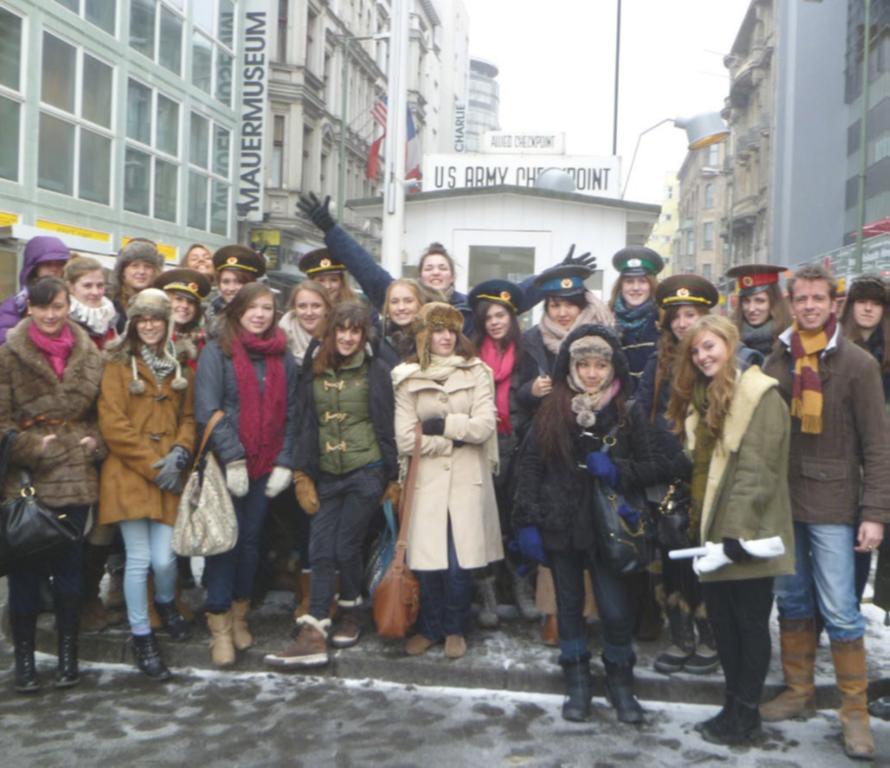
Awarding Body: AQA
This qualification will take you on a journey through some of the most significant events in modern world history, linking these events with the present and basing your understanding on a wide variety of historical evidence. The focus will not just be on learning history, but learning from history!
History continues to be a popular option choice at GCSE. It is not only fascinating, but it is also recognised by the Russell Group of top universities as one of their highly rated ‘facilitating subjects’. History is also highly regarded by future employers too, opening the door to many professional careers.
History is more than just a practical choice though. It is about real people and gripping stories. It is about the eras, individuals and issues that have shaped the world around us, and our own identities within it.
Our new specification consists of two assessments, each worth 50% of your final grade. There is no longer any coursework or controlled assessment.
Assessment 1: Written exam – 2 hours
• Section A: focuses on the key developments in a country’s history over a 50-year period. We will be studying Option 1D: USA 1920-1973: Opportunity & Inequality in which you will learn about the huge changes that took place within American society during these years.
• Section B: focuses on the wider modern world as a depth study with an emphasis on understanding rising tensions and growing conflict. We will be studying Conflict and Tension between East and West, 1945-1972, focusing on the dramatic events that surrounded the ‘Cold War’.
Assessment 2: Written exam – 2 hours
• Section A: is a thematic study looking at the key developments that have taken place over a long sweep of time. We will be studying Option 2A Britain: Health and the people. We will learn about the extraordinary journey of progress (and occasional regress) that medicine and public health has undergone from Roman times right up to the present day and the controversies that surround health care in the 21st century.
• Section B: is specifically focused on learning about a period of British history
in depth and will include the study of a historic environment. We will be studying Elizabethan England, focusing on the final 35 turbulent years of her reign and weighing the extent to which this was a ‘Golden Age’.
Awarding Body: Eduqas
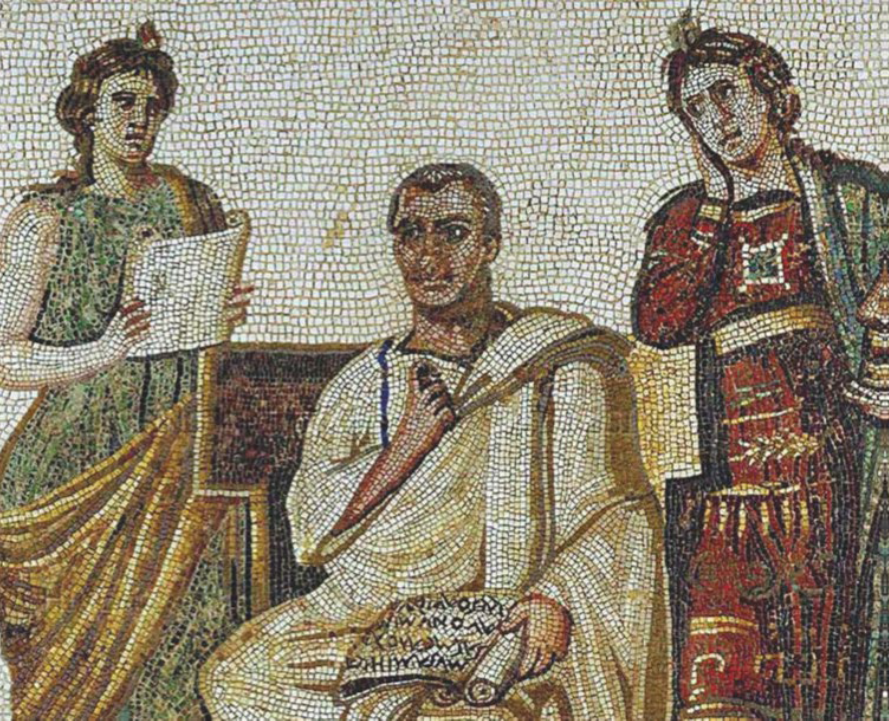
From the role of women in ancient Rome and the nature of marriage in Roman society to the study of the character of the Emperor Nero, Latin involves discussion, analysis and the translation of original ancient texts. The first three years of Latin at Key Stage 3 are the foundation for the GCSE course. We continue to develop language skills, grammatical understanding and vocabulary knowledge through translation and comprehension work. Further aims of the course are to read and appreciate some of the literature in the original language and to acquire a wider understanding of the life, history and customs of the Roman people and their contribution to the culture of Europe.
We read from a variety of authors, e.g. the poetry of Virgil, Ovid, and selections from Suetonius, Pliny and Juvenal.
Three units will be examined for GCSE, these are:
• One language unit consisting of unseen prose translation and answering comprehension questions. The girls will also choose between answering questions on accidence and syntax or translating short English sentences into Latin.
• One unit comprising Latin Literature and Sources centred around the theme of “Love and Relationships”
• One unit consisting of a prescription of Latin forming a narrative from an author such as Suetonius.

Awarding Body: AQA
Specification: 8652, 8692
French and Spanish GCSE courses aim to:
• encourage students to develop confidence in, and a positive attitude towards, French/Spanish and to recognise the importance of languages.
• provide a strong linguistic and cultural foundation for students who go on to study French/Spanish at a higher level post-16.
• develop their ability and ambition to communicate independently in speech and writing with speakers of the language for authentic purposes and about subjects which are meaningful and interesting to them.
• build students’ confidence and broaden their horizons, enabling them to step beyond familiar cultural boundaries, develop new ways of seeing the world, and better understand relationships between the foreign language and the English language.
The four skills (listening, reading, speaking and writing) are assessed in terminal examinations each accounting for 25% of the overall grade.
Pupils are assessed on three main themes, namely:
• Theme 1: People and lifestyle (Identity and relationships with others, Healthy living and lifestyle, Education and work)
• Theme 2: Popular culture (Free-time activities, Customs, festivals and celebrations, Celebrity culture)
• Theme 3: Communication and the world around us (Travel and tourism, including places of interest, Media and technology, The environment and where people live)
The elements assessed on the four papers:
• Paper 1: Listening
– Understanding and responding to spoken extracts comprising the defined vocabulary and grammar for each tier
– Dictation of short, spoken extracts
Paper 2: Speaking
– Speaking using clear and comprehensible language to undertake a role-play
– Carry out a reading aloud task
– Talk about visual stimuli
Paper 3: Reading
– Understanding and responding to written texts which focus predominantly on the vocabulary and grammar at each tier
– Inferring plausible meanings of single words when they’re embedded in written sentences
– Translating from French/Spanish into English
Paper 4: Writing
– Writing text in the language in a lexically and grammatically accurate way in response to simple and familiar stimuli
– Translating from English into French/Spanish.
Awarding Body: Eduqas
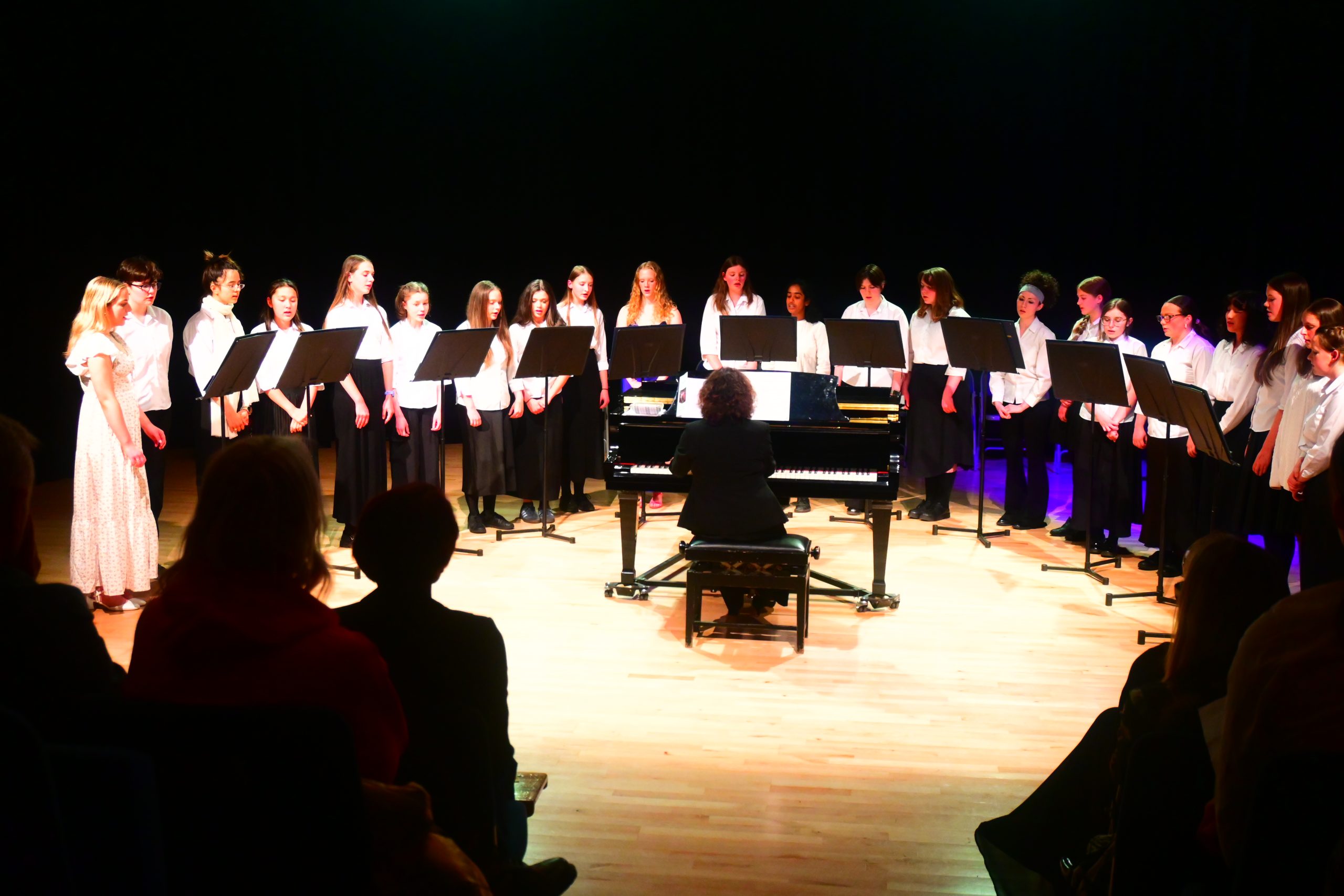
GCSE Music offers students the opportunity to not only perform and create their own music but also to listen to a wide variety of musical styles, ranging from classical and world music to musicals and popular genres. This course balances practical music-making with listening and understanding and students will enjoy discovering what makes a piece of music unique and gets your toes tapping!
• Component 1: Performing (30%)
You will perform one piece as a soloist and one piece as part of an ensemble. Performances take place in the final year of the exam and must last a minimum of 4 minutes in total.
• Component 2: Composing (30%)
During the course we compose in various styles and learn compositional techniques. Two compositions are completed under controlled conditions and submitted. One composition is to a brief set by the exam board and the other is in the style of your choosing.
• Component 3: Appraising (40%)
You will listen to a wide variety of music and learn more about how and why it was written and performed.
There are four different areas of study:
1. Musical forms and devices
2. Music for ensemble
3. Film music
4. Popular music
Two pieces will be studied in greater depth:
• Badinerie by J.S.Bach for Flute and String Orchestra with Harpsichord
(Final movement, Orchestral Suite No.2 in B minor, BWV 1067)
• Africa: Toto
This area of the subject is assessed by a written listening examination lasting
1 hour 15 minutes in the summer of the Upper 5 year.
Awarding Body: OCR
Specification: Physical Education (9-1) – J587
Studying GCSE Physical Education will open your eyes to the amazing world of sports
performance. Not only will you have the chance to perform in three different sports through the non-examination assessment component, you will also develop wide ranging knowledge into the how and why of physical activity and sport.
Component 01: Physical factors affecting performance
Students explore how parts of the human body function during physical activity and the physiological adaptations that can occur due to diet and training. They also develop skills in data analysis, and an understanding of the principles of training, why we train in different ways and how training plans can be made to optimise results.
There are two topics:
• Applied anatomy and physiology
• Physical training.
Component 02: Socio-cultural issues and sports psychology
Students develop their knowledge of the social-cultural and psychological influences on levels of participation in sport, and how sport impacts on society more broadly. This includes the individual benefits to health, fitness and wellbeing of participating in physical activity, as well as the influences of commercialisation, sponsorship and the media.
There are three topics:
• Socio-cultural influences
• Sports psychology
• Health, fitness and wellbeing.
Component 03: Practical performances
Students are assessed in performing three practical activities, where they must demonstrate effective performance, the use of tactics or techniques and the ability to observe the rules and conventions under applied conditions.
Component 04: Analysis and evaluation of performance (AEP)
Students are required to demonstrate their ability to analyse and evaluate their own or a peer’s practical performance to produce an action plan for improvement.
How will you be assessed?
• Non-Exam Assessment (NEA). Three practical performances
• NEA. One Performance Analysis task.
• A total of two hours’ assessment split over two examination papers (2×1 hour) taken at the end of the two-year course.
• A wide range of question types including multiple choice, single mark, short answer and extended response questions.
• The opportunity to demonstrate your knowledge of the theory and performance skills in both your NEA and through the examinations.

Awarding Body: AQA
Specification: Religious Studies A (8062)
This GCSE RS specification is designed to inspire students to engage with major issues that are interesting, relevant and important in the 21st century world. By taking this course, you can gain a deeper understanding of two religions and explore key themes in philosophy and ethics. You will develop your skills of critical evaluation and analysis while broadening your knowledge of the world around you.
This course is divided into two components. These are:
1. The study of religions: beliefs, teachings and practices.
2. Thematic studies.
For component one, we will be exploring the beliefs and practices of Christianity and Islam, the two largest world religions. This component will be examined by one examination of 1 hour 45 minutes.
For component two, you will explore different religious and non-religious perspectives on four themes. These are:
• Relationships and Families
• Religion and Life
• The Existence of God and Revelation
• Religion, Peace and Conflict
Within these four broad themes, you will have the opportunity to learn about, discuss and evaluate a wide range of topics, such as: gender and sexuality; marriage and divorce, philosophical arguments about God; religious experience; animal rights; medical ethics.
This second component will be examined by another written examination of
1 hour 45 minutes.
A-levels
Our oldest students receive unrivalled individualised support to fulfil their potential in preparation for their next steps beyond the school gates. The broad curriculum on offer facilitates access to a full range of university courses, while the Sixth Form’s cheerful family atmosphere and small class sizes give each student the bespoke academic, university and pastoral advice crucial for success.
A-level option subjects:

The aim of A-level Art & Design is to develop your intellectual, imaginative and creative abilities. The course will enable you to work within a broad context of Art & Design, covering a range of disciplines including drawing, painting, sculpture, mixed media and both digital and traditional film and darkroom photography.
ENTRY REQUIREMENTS
We would normally expect you to have gained a grade 6 or above in GCSE Art & Design. However, if you have a lower grade, or are interested in the subject and have not taken GCSE, then please come and talk to us. Interest in the subject is the most important qualification!
LINKS WITH OTHER SUBJECTS
Current and past students have combined A-level Art & Design with Humanities, Science, Maths, and Modern Foreign Languages. You will enjoy developing your creative thinking and practical skills alongside your other subjects. The problem-solving and contextual skills in Art are, in fact, highly complementary alongside other academic disciplines.
HIGHER EDUCATION AND CAREER OPPORTUNITIES
Art & Design is a fully recognised A-level course for university entry. It is one of the fastest growing areas of study nationally, with skills such as visual literacy and creative thinking being greatly valued by both universities and employers.
Many career opportunities are widened by a qualification in Art & Design (e.g. Architecture, Interior Design, Engineering, Industrial Design, Product Design, Fashion, Creative Direction, Marketing, Media and Computer Science) as well as the obvious routes into Art & Design degrees.
This practical, creative, problem-solving course will equip you with the skills and confidence to be successful in a very wide area of careers.
Recent destinations and courses for girls that have studied Art & Design A-level are varied. They include Architecture, Product Design, Theoretical Physics, Land Management, Design Engineering, Medicine, History and English, as well as going onto Art Colleges to study Fashion, Illustration, Fine Art and many more.
COURSE CONTENT
Exam Board: OCR
Unit 1: Personal Investigation – 60%
This component comprises two discrete but linked elements.
Element 1: Practical portfolio
This is a practical portfolio of your work. You will develop your skills and own interests during the course and will work on projects where you choose and develop your own theme. You may work in any media and final pieces can be paintings, drawings, mixed media, sculptures, installations, photography and other outcomes. The practical work accounts for 80% of the Personal Investigation marks.
Element 2: Related Study
This is a written and illustrated study (guide 3000 words). It will closely relate to the theme of your practical portfolio work. The written study accounts for 20% of the Personal Investigation marks.
Unit 2: Externally Set Task – 40%
The question paper is released early allowing you ample time to plan and prepare for a fifteen-hour period of controlled time in which to realise your ideas into a final outcome. You choose one theme to develop from the many choices on the set-task paper.
The course content will include:
• Drawing
• Painting
• Photography both digital and darkroom
• Life-drawing
• Critical and Contextual studies
• Sketchbook development
• Mixed media work
• Sculpture and 3D work
• Visiting exhibitions
• Creative and experimental use of media
• Organising and presenting work
• Analysis and evaluation
We have a dedicated Sixth Form Art Studio where you are taught and which can be used outside of lesson times. You will be able to leave work out and return to it. Each student has their own storage space.
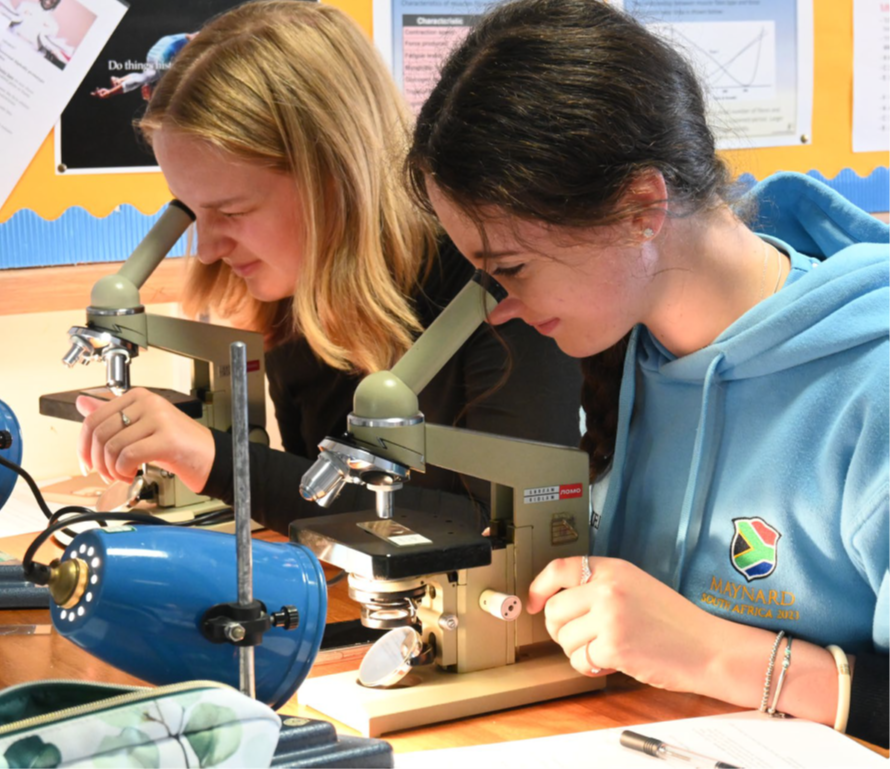
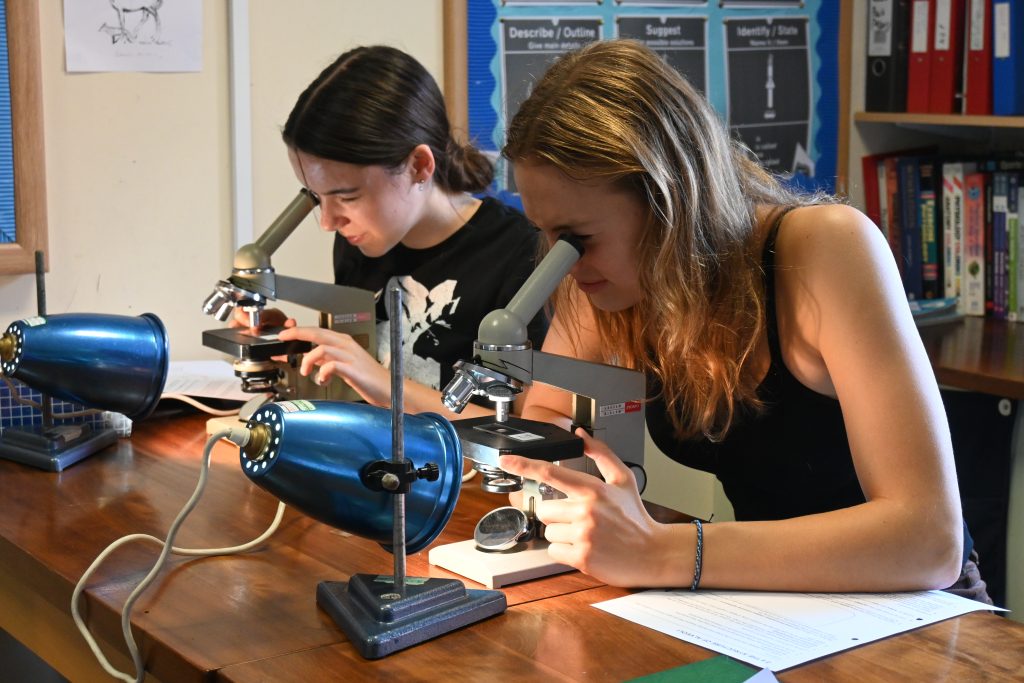
We are all fascinated by the intricate processes and relationships found in living organisms and communities. Who has not been fascinated by David Attenborough describing the perils and hardships of the living world? But the knowledge of biological issues is also central to the way we lead our lives, from understanding health issues to considering the welfare of the planet. Many new and exciting areas of employment have opened up with the development of new biological technologies and knowledge such as the human genome project and stem cell technology.
A-level Biology at The Maynard reflects the excitement and challenge of the new Science. We follow the AQA syllabus which supports and challenges the students as they develop their understanding of the living world. Students are taught in small groups with access to a rich variety of resources with a strong emphasis on independent learning and practical activities.
Our students achieve excellent results and go on to study a wide variety of biologically related courses from Medicine, Nursing, Veterinary Science and Dentistry to Food Science, Psychology, Biology and Biochemistry to name just a few.
BIOLOGY A-LEVEL: THE CONTENT
A-level Biology is divided into eight topics. Four are taught in Lower 6 and four in Upper 6. The topic titles are:
Lower 6 year
• Biological molecules
• Cells
• Organisms exchange substances with their environment
• Genetic information, variation and relationships between organisms
Upper 6 year
• Energy transfers in and between organisms
• Organisms respond to changes in their internal and external environments
• Genetics, populations, evolution and ecosystems
• The control of gene expression
ASSESSMENT
The A-level course is assessed by three terminal examinations each lasting 2 hours. Paper 1 covers all the Lower 6 topics and Paper 2 covers all Upper 6 topics. The final paper examines all eight topics and includes a synoptic essay. The papers will include questions that target the conceptual and theoretical understanding of experimental methods. In addition, practical skills will be assessed and reported separately as a Science Practical Endorsement. This will be awarded a ‘pass’ or ‘fail’ grade and will not affect the overall A-level grade.
Learning Biology does not just happen in the classroom. An important part of the course is fieldwork and we offer a variety of opportunities to study biology through extracurricular trips.
We encourage students to build up their knowledge by wider reading and debate. Our school library takes several relevant magazines and we run a Science Reading Group, as part of ESP, where all Science-based Sixth Formers are encouraged to debate the findings of recent scientific articles. All students also have the opportunity to take part in the Biology Olympiad, an exciting opportunity to test their knowledge to the full.
ENTRY REQUIREMENTS
The qualification builds on the knowledge, understanding and practical skills that you gained in GCSE Biology or in GCSE Combined Science. You should have at least a grade 7 in GCSE Biology (or 7:7 grades in Combined Science). You should have at least a grade 6 in GCSE Mathematics, as numerical and mathematical skills are important in Biology and form 10% of the assessment, and at least a grade 7 in English Language as you will need to be able to communicate effectively.

Business Studies is about the workings of a business. It looks into what makes a successful business and examines a broad range of the issues and challenges that businesses face. It then looks at possible ways of solving or reducing those issues. The subject also studies the external environment in which businesses operate.
TOPICS STUDIED INCLUDE:
• Marketing
• Business aims and objectives
• Cash flow and break-even analysis
• Human Resource Management
• Sources of Finance
• Balance Sheets and Income
• Statements Decision making
• The role of stakeholders
• Motivation
• Ratio analysis
ASSESSMENT
Examination questions are in the form of multiple-choice and data response questions. These require relatively short written answers. There is no coursework. We study the AQA specification.
ENTRY REQUIREMENTS
Business Studies is a new subject for all students who join the course. An interest in current affairs will make the study of this subject even more fascinating.
HIGHER EDUCATION AND CAREER OPPORTUNITIES
You have a wide choice. A Business Studies qualification is highly respected by universities and employers.
You could take a degree in Business – there is an extremely wide range of Business courses offered by universities. Some of these are aimed at specific businesses such as hospitality, tourism and banking while others offer a more general approach. Many of these courses now last for four years with one year being spent on a placement in industry.
Business Studies is also an excellent foundation for many other higher education courses such as Geography, Politics, Law and History.
You could go directly into employment. Opportunities are very wide but Business is particularly valued for careers in Business, Management, Finance and Insurance.
THE STUDENT OF BUSINESS WILL:
• Find the world of business and finance easier to understand and explain.
• Acquire strong skills of analysis and evaluation, especially when addressing business issues.
• Be able to find jobs more quickly and command higher starting salaries than many.
• Become familiar with Business English (particularly important for students from abroad).
COURSE CONTENT
Exam Board: AQA
The A-level is examined at the end of a two year course. There are three papers:
PAPER 1 & PAPER 2
A combination of multiple choice and short written questions covering the whole specification.
PAPER 3
Questions based on a written case study.
To obtain a detailed specification of the course please go to:
https://filestore.aqa.org.uk/resources/business/specifications/AQA-7131-7132-SP-2015.PDF
For more information, please contact Mrs Ellen Spencer: [email protected]
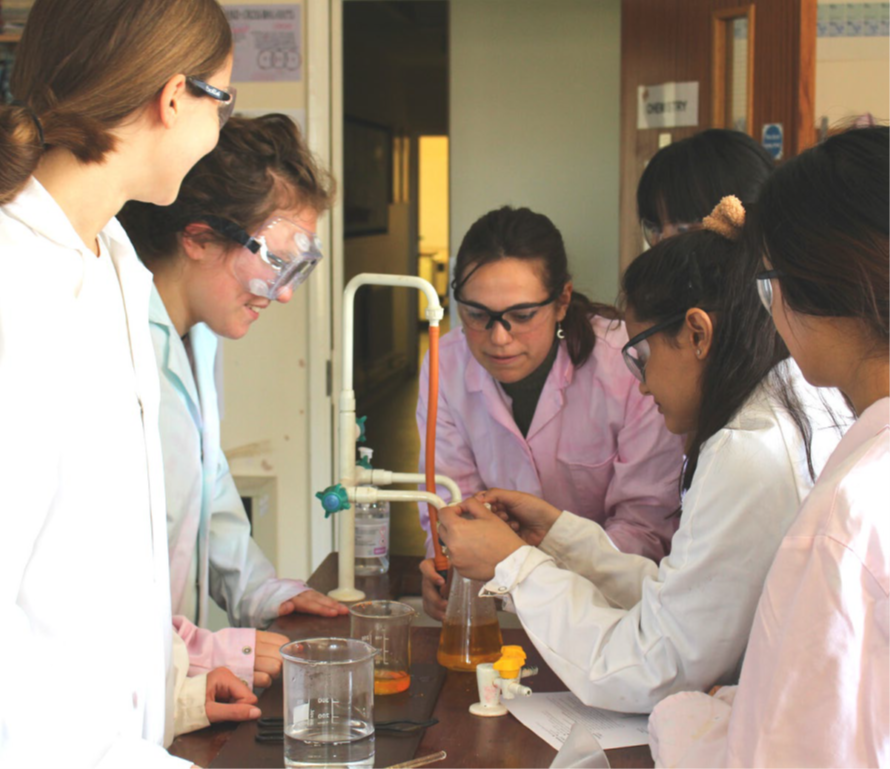
Chemistry is very popular at The Maynard. We have well-equipped laboratories with dedicated and enthusiastic teachers. Our students go on to study Chemistry, Natural Science, Medicine, Veterinary Science, Engineering and a wide range of other degrees. They pursue careers in all manner of disciplines, from Dentistry to Business Management to Food Science.
We offer the Edexcel A-level Chemistry syllabus. The course aims to build on the skills and knowledge acquired at GCSE and apply them to a wide range of situations. It allows us to look more closely at the particles and processes that make up the material world and to be able to explain and predict their behaviour. There is a large mathematical component and an emphasis on analysis and problem solving.
BENEFITS OF STUDYING CHEMISTRY
Chemistry is an ideal grounding for a wide range of careers and provides analytical skills that are useful in any profession. It requires students to acquire knowledge, use mathematical skills, be very clear and precise in their use of language, be able to use their imagination, debate issues, solve problems, make predictions, and acquire practical skills. The developments taking place in alternative fuels, nanotechnology and computing are driven by advances in materials science. Students with an understanding of Chemistry will be in great demand for many years to come, both for their knowledge and their skills.
ENTRY REQUIREMENTS
This qualification builds on the knowledge, understanding and practical skills that you gained in GCSE Science and GCSE Additional Science or GCSE Chemistry. You should have at least a grade 7 in these subjects. You should also have at least a grade 7 in GCSE Mathematics, as numerical and mathematical skills are important in Chemistry. You will need to be able to communicate effectively, be able to plan and carry out research, and think critically about problems.
EXAMINATIONS
PAPER 1: ADVANCED INORGANIC AND PHYSICAL CHEMISTRY (9CH0/01)
30% of the A2; 1 hour 45 minutes; 90 marks
Topic 1: Atomic Structure and the Periodic Table
Topic 2: Bonding and Structure
Topic 3: Redox I
Topic 4: Inorganic Chemistry and the Periodic Table
Topic 5: Formulae, Equations and Amounts of Substance
Topic 8: Energetics I
Topic 10: Equilibrium I
Topic 11: Equilibrium II
Topic 12: Acid-base Equilibria
Topic 13: Energetics II
Topic 14: Redox II
Topic 15: Transition Metals
PAPER 2: ADVANCED ORGANIC AND PHYSICAL CHEMISTRY (9CH0/02)
30% of the A2; 1 hour 45 minutes; 90 marks
Topic 2: Bonding and Structure
Topic 3: Redox I
Topic 5: Formulae, Equations and Amounts of Substance
Topic 6: Organic Chemistry I
Topic 7: Modern Analytical Techniques I
Topic 9: Kinetics I
Topic 16: Kinetics II
Topic 17: Organic Chemistry II
Topic 18: Organic Chemistry III
Topic 19: Modern Analytical Techniques II
PAPER 3: GENERAL AND PRACTICAL PRINCIPLES IN CHEMISTRY (9CJO/03)
40% of the A-level; 2 hours 30 minutes; 120 marks
Overview of content
Questions in paper 3 may draw on any of the topics in this specification. The paper will include synoptic questions that may draw on two or more different topics listed. The paper will include questions that assess conceptual and theoretical understanding of experimental methods (indirect practical skills) that will draw on students’ experiences of the core practicals.
OVERVIEW OF ASSESSMENT FOR ALL PAPERS
• The papers may include multiple-choice, short open, open-response, calculations and extended writing questions.
• The paper will include questions that target mathematics at Level 2 or above (level 2 corresponds with GCSE).
• Some questions will assess conceptual and theoretical understanding of experimental methods.
Science Practical Endorsement: 9CH0/04
Internally assessed and externally moderated by Pearson Edexcel.
OVERVIEW OF CONTENT
This qualification will give students opportunities to use relevant apparatus and techniques to develop and demonstrate specific practical skills. These skills must be assessed through a minimum of 12 identified practical activities within each qualification. The assessment outcomes will be reported separately on students’ certificates as either ‘pass’ or ‘fail’. To achieve a pass, students must demonstrate that they are competent in all of the practical skills listed in the subject content requirement for chemistry, as published by the Department for Education.
The Endorsement will not contribute to the overall grade for this qualification, but the result will be recorded in your final certificate.
The core practicals will be assumed knowledge and there will be questions on practical techniques. This could include the analysis and evaluation of sample data or designing an experiment to investigate a reaction. The questions will relate to practical you will have carried out.
At The Maynard we carry out many more experiments than the 16 core practicals suggested by the examiner.
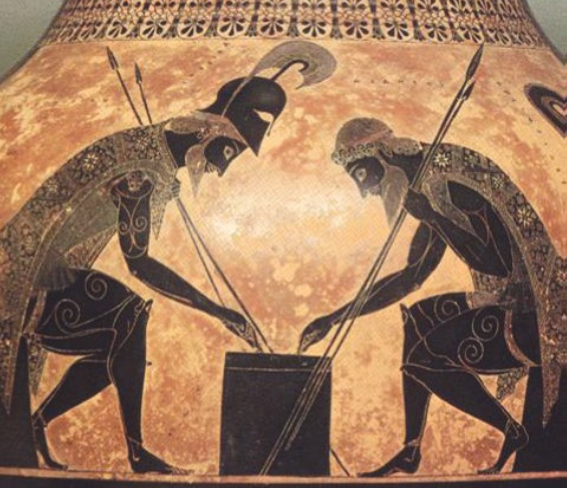
This course is becoming increasingly popular both at school and university level and offers a variety of topics from the Ancient Greek and Roman world. You will be expected to study each topic in detail with special reference to selected texts and, since the material is all in English, you can explore the topics in depth and will have the opportunity to relate various works of literature to their social and cultural contexts. You will be encouraged to appreciate literary technique, to collect relevant evidence and to develop and present arguments based on your findings.
The course is not only literary but also involves the appreciation of social values and an understanding of both the historical and archaeological background. By the end of the course you will be able to appreciate distinctive Ancient Greek and Roman ways of thought and feeling. The course also involves the aesthetic appreciation of works of art. As well as studying art and literature in school there will be opportunities to attend performances of Greek plays and to visit museums in which material remains from the Ancient World are on display.
ENTRY REQUIREMENTS
There are no formal entry requirements for A-level Classical Civilisation.
LINKS WITH OTHER SUBJECTS
Classical Civilisation will be of particular relevance to those of you studying English, History, Art or Drama. The ideas formulated in the Greco-Roman world have been fundamental to the development of medieval and modern Europe while the art and literature of that society have been dominant influences upon European writers and artists for many centuries.
HIGHER EDUCATION AND CAREER OPPORTUNITIES
Classical Civilisation is fully recognised by University Admissions Officers. You can study it in its own right at university or in combination with other subjects including a Classical language. Some people are put off from studying Classics because it doesn’t seem to lead to any obvious form of employment at the end of it. They couldn’t be more wrong. Certainly an A-level in Classics is not vocational, in the sense of funnelling you directly into one particular form of employment, as Law or Medicine do, but Classicists are very highly prized by employers of all kinds.
Classics provides mental training in a whole range of different disciplines, and produces students of exceptional intellectual flexibility. In our world of rapid social and technological change, it is the capacity to react to new and unforeseen developments with flexibility which employers value most, and it is widely recognised that Classics and related subjects produce just the kind of graduate they are looking for, with an unparalleled capacity to adapt to new circumstances and learn new skills.
Examples of professions which attract Classicists include:
1. Accountancy 12. Information Technology
2. Law 13. Academia
3. Theatre and Performing Arts 14. Archive Work
4. Media 15. Auction House Work
5. Teaching 16. Archaeology
6. Arts Management 17. Publishing
7. Journalism 18. Social Work
8. Media 19. Museum Work
9. Management Consultancy 20. Politics
10. Librarianship 21. Civil Service
11. Military
COURSE CONTENT
Exam board: OCR
The A-level course is made up of 3 components:
1. Component 1: The world of the Hero. Homer’s Iliad and Virgil’s Aeneid. (40% of total A-level)
2. Component 2: Culture and the Arts. Imperial Image. Encompassing the study of material and visual culture. (30% of total A-level)
3. Component 3: Beliefs and Ideas: Love and Relationships. (30% of total A-level)
YEAR 1
The World of the Hero
The works of Homer were considered by the Greeks to be the foundation of Greek culture, standing at the beginning of the Western literary canon. Study of Homer’s Iliad provides students with the opportunity to appreciate the lasting legacy of the Homeric world and to explore its attitudes and values. Not only do we analyse the text from a literary point of view, but we also approach the epic from historical, archaeological and sociological contexts. We study the text’s oral tradition, and its transmission; the structure of the epic genre; narrative techniques; the language of Greek epic, including its formulae and similes. In this module we also focus on the concept, values and behaviour of a hero including the ideas of time (honour) and kleos (reputation).
Imperial Image: Augustus
The idea of a politician ‘spinning’ their public image is one which is very familiar from our contemporary media; and so this exploration of a Roman politician and his successful propaganda campaign is both highly relevant and engaging for learners. Augustus Caesar was, through careful management of public opinion, able to convince a society that was fundamentally anti-monarchical to turn away from its republican values and to accept one-man rule. Through an examination of the literature and visual/ material culture of the period, this component allows learners to examine the ways in which Augustus conveyed his personal brand to all social classes of Rome.
YEAR 2
Virgil’s Aeneid
The principle focus of this module is on Rome in the first century BC, and the epic literature produced by Rome’s finest poet and the Greek works which influenced him. We study the composition of both Homer’s Iliad and Virgil’s Aeneid; their plot, narrative techniques including the eloquent and moving speeches; the poets’ use of descriptive techniques including similes and imagery; characterisation. We also study in detail the classical concepts of heroism, honour and reputation, family, women, the role of the gods, the power of fate, the portrayal of war, moral values and the role of Aeneas in Rome’s imperial destiny. The social and cultural environment is important for the study of a work of his magnitude, and so we also cover the topics of Virgil’s relationship to the emperor Augustus, and the political strife in Rome which led to the creation of the empire and Augustus’ ascension.
Love and Relationships
Ideas about love and relationships are key aspects of the literature, thoughts, and ethics of any society. This component offers the opportunity for learners to recognise and relate to the passions, frustrations and delights of love in the ancient world. This unit will generate interesting and important discussions about love, desire, sex, sexuality and the institution of marriage.
Ancient ideas about men, women and marriage enable learners to discuss the reality of love and relationships in everyday life, whilst study of Seneca and Plato provides a more conceptual approach. Throughout this material learners will be able to draw comparisons and make judgements about ideal and reality, and the nature of ‘right’ and ‘wrong’ ways to love or be loved.
The study of poetry forms the second half of the unit. Sappho is one of very few female voices from the ancient world; the context of her life is fascinating, and her verse is powerful and evocative. Ovid offers a lighter presentation of relationships and concentrates on the fun and flirtation of budding romances.
Computer Science is a dynamic and practical subject, allowing students to apply theoretical principles to real-world systems. It combines creativity and innovation, offering a unique way to understand the modern world through a digital lens.
The course aims to develop:
• A solid understanding and the ability to apply fundamental principles of computer science, including abstraction, decomposition, logic, algorithms, and data representation.
• Skills to analyse problems in computational terms, with hands-on experience in writing and developing programs to solve them.
• The capacity to think critically, logically, creatively, and analytically.
• An understanding of how different aspects of computer science interrelate.
• Strong mathematical skills that underpin problem-solving and analytical thinking.
Computer Science strongly complements subjects like Mathematics and Physics. The logical thinking, problem-solving, and analytical skills developed in Maths directly support the algorithms and data manipulation in Computer Science. Meanwhile, the understanding of physical systems in Physics aids in grasping the hardware and mechanics behind computing. The intersection of these subjects gives students a holistic view of how digital systems can be applied to solve both theoretical and practical challenges.
As CAS (Computing at School) states: “At its heart lies the notion of computational thinking: a way of approaching problems that goes beyond software and hardware, providing a framework to reason about systems and challenges.”
A-level Computer Science equips students with vital skills for a rapidly changing, technology-driven world. With technology playing an ever-growing role in every industry, this course is highly relevant. It allows flexibility, enabling students to learn using various programming languages suited to their needs and interests.
This qualification not only values computational thinking but also helps learners to design systems, solve complex problems, and explore the capabilities and limitations of both human and machine intelligence. Through the project-based approach, students will develop critical skills that are essential for success in Higher Education and the workplace, with projects tailored to their individual aspirations and goals.
HIGHER EDUCATION AND CAREER OPPORTUNITIES
Studying Computer Science opens doors to a range of exciting career paths, such as Software Engineering, Game Development, Forensic Computing, Artificial Intelligence, and Information Systems. Careers in tech continue to grow and evolve, offering numerous opportunities, including:
• Expanding industries based on artificial intelligence, automation, and robotics.
• The increasing digital transformation of traditional industries.
• A strong drive to increase female representation in tech, where women currently make up only 7% of the workforce.
A-level Computer Science prepares Maynard students for these in-demand careers, ensuring they have the technical and analytical skills needed for success.
COURSE CONTENT
Exam Board: OCR
COMPUTER SYSTEMS
This component introduces students to the inner workings of the Central Processing Unit (CPU), data exchange, software development, and the legal and ethical issues surrounding technology. The foundational knowledge gained is essential for computational thinking and programming skills.
ALGORITHMS AND PROGRAMMING
Building on the Computer Systems component, students will:
• Master computational thinking and apply it to a wide range of problems.
• Learn the principles of solving problems using computational methods.
• Use algorithms to break down and analyse complex problems.
PROGRAMMING PROJECT
In this practical project, students will analyse, design, develop, test, evaluate, and document a program in a suitable programming language. They will apply computational thinking principles and an agile development approach to solve a real-world coding challenge.
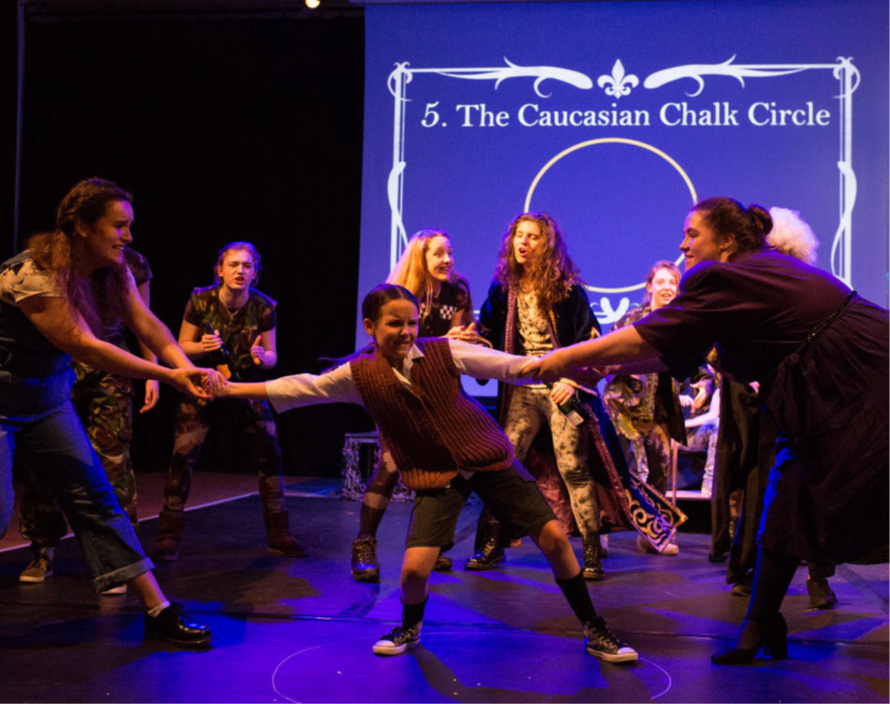
Studying Drama and Theatre at A-level means experiencing professional theatre workshops with contemporary companies, seeing live professional theatre both locally and nationally, working practically through your studies exploring new, diverse and creative techniques in performing, directing and designing and, of course, having the opportunity to create and produce your own work.
This is an exciting and dynamic course which enables students to:
• Challenge themselves in the study of directing, performing, and designing their own work, both devised and scripted.
• Explore the work of both contemporary and historically influential theatre practitioners.
• Act as theatre critics, evaluating and analyzing professional performances.
• Produce a historic play following their own unique director’s concept.
COURSE CONTENT
Exam Board: Edexcel
Component 1: Devising (40% Coursework)
Devise an original performance piece using one key extract from a performance text and a theatre practitioner as stimuli. Centre choice of text and practitioner. Performer or designer routes available.
Component 2: Text in Performance (20% Coursework)
A group performance/design realisation of one key extract from a performance text. A monologue performance/design realisation from one key extract from a different performance text. Centre choice of performance texts.
Component 3: Theatre Makers in Practice (40% Written Exam)
A group performance/design realisation of one key extract from a performance text. A monologue performance/design realisation from one key extract from a different performance text. Centre choice of performance texts.
Section A – Live theatre evaluation.
Section B – Page to Stage: Realising a Performance.
Section C – Interpreting a Performance Text.
A-level Drama students have lessons in the well-equipped Drama Studio or the Performing Arts Centre and the Main School Hall, all of which are furnished with stage lighting and sound systems. Performances also take place in these spaces but we do encourage students to make use of our surroundings and experiment with site-specific work whenever possible.
To that end, we attend a diverse collection of performances across the two years designed to challenge and inspire. Highlights include: Brecht’s ‘The Threepenny Opera’ at The National Theatre, with an accompanying day-long student experience; Complicité’s ‘Drive your Plow’, ‘Beautiful Burnout’, the emotionally charged ‘Lovesong’ and the electric ‘Othello’ all from movement theatre company Frantic Assembly at Plymouth Theatre Royal; and the fascinating ‘Ocean at the End of the Lane’ which has fed our imaginations and been the basis of the live theatre section on the C3 written exam for the past few years.
We believe that all A-level students should have the opportunity to work with professional companies – our students have attended practical workshops with Pilot Theatre Company, Frantic Assembly, Theatre Alibi and the internationally acclaimed Complicité.
We are interested in nurturing informed, intelligent appreciation of all types of theatre performance, enabling our students to make exciting, creative choices within their own work.

Economics is a Social Science which attempts to understand the behaviour of individuals, governments, firms and nations in attempting to reconcile unlimited wants with scarce resources. It seeks to find the right answers for many of the problems facing these agents.
In this course, economic theory is applied to ‘real world’ current affairs questions such as:
• What is the “Cost of Living Crisis” and how does it affect us?
• Should we provide more aid to poor countries?
• Should we protect UK jobs from foreign competition?
• Why does the UK import so much but export so little and does it matter?
• Do supermarkets give value for money or do they exploit the consumer and their suppliers?
• What is globalisation and why does it create such controversy?
• What is the best way of reducing global warming?
• Will raising the National Minimum Wage reduce poverty?
• Are big firms better for society then many small competing ones?
• To what extent should governments interfere in the activities of firms?
• Has Covid changed the economy forever?
• Is a ‘strong’ pound good for the UK economy?
• How can we avoid financial crisis such as the Great depression (1930’s) and the 2008 Credit Crunch?
• What are the implications of Brexit?
ASSESSMENT
Examination questions are in the form of Multiple Choice and Data Response questions. The latter are usually based on newspaper articles relating to current economic events. These require relatively short written answers. There is no coursework.
COURSE CONTENT
Exam Board: Edexcel
The A-level is examined at the end of the two year course. There are three papers.
PAPER 1:
Markets and Business Behaviour. (Microeconomics: looking at individuals and business).
PAPER 2:
The National and Global Economy. (Macroeconomics: looking at countries and the world).
PAPER 3:
Microeconomics and Macroeconomics (looking at both together).
ENTRY REQUIREMENTS
Minimum Grade 6 in GCSE Maths. An interest in current affairs will make the study of this subject even more fascinating.
HOW WILL THE STUDENT BENEFIT FROM STUDYING ECONOMICS?
The student of Economics will:
• Find current affairs easier to understand and more interesting.
• Acquire strong skills of analysis and evaluation, especially when addressing current affairs issues.
• Be able to find jobs more quickly and command higher starting salaries than most.
• Will become familiar with Business English (particularly important for students from abroad).
HIGHER EDUCATION AND CAREER OPPORTUNITIES.
You have a wide choice. An Economics qualification is highly respected by universities and employers. You could take a degree in Economics – all universities offer this subject. Economics is also an excellent foundation for many other higher education courses such as Business Studies, Geography, Law, Politics and History. It also combines very well with Mathematics. You could go directly into employment.
Opportunities are wide, but Economics is particularly valued for careers in business management and finance.

English, with its combination of technical and creative elements, is a wide-ranging subject with no clear limits – it is a humane and civilising project and, in our experience, pupils enjoy English in the Sixth Form because their own personal contribution really matters.
The English Department, with its wealth of material and intellectual resources, aims to equip our students with the skills needed to speak confidently and fluently, and to write with accuracy and sophistication; we aspire to instil in students a lasting enthusiasm for literature and to ensure that this wonderful subject is something rich and strange for all our students for all their time here – and, as importantly, beyond.
THE COURSE
The course is very wide-ranging, and we expose students to as great a variety of drama, poetry and fiction as possible. The coursework module also allows students with a specialised interest in a particular author or period to explore and to pass on their personal enthusiasms, as we give them free rein in choosing one of their texts. Discussion of literature ranges broadly across historical, political, philosophical, moral and psychological issues as well as offering an insight into the history of the English language and linguistic change. We study literature as a means of questioning our deepest held beliefs, whilst also allowing us to empathise with situations and states of mind we are yet to encounter, so that when we do face them we are all the better prepared.
With specialist support, engaging lessons and a collegiate approach to learning it’s no wonder that the English Department is renowned for its successes at A-level. Many girls go on to read English at university; extension sessions and specialist support through the application process are offered by the department.
OUTSIDE THE CLASSROOM
English in the Sixth Form isn’t all about exams. We offer a rich programme of cultural activities that enhance the students’ response to literature. Sixth Formers run the Oxford University Ten Minute Book Club, experiencing and discussing wide-ranging texts recommended by tutors from Oxford. We maintain that drama and texts should be seen and experienced, and so we organise regular theatre trips including, last year, a trip for both Lower 6 and Upper 6 to see ‘A Streetcar Named Desire’ in London, and ‘Othello’ in Stratford. Where possible, we attend screenings of national productions.
We also look to explore the curriculum in environments outside of the classroom whenever we can; for example, A-level students attended and enjoyed a reading by former Poet Laureate, Simon Armitage in the spring term.
OUR ANNUAL STRATFORD TRIP
We believe that our famous annual trip to Stratford with the Lower 6 is a unique and enriching experience for our girls; it ignites a spark about Shakespeare and about literature that goes well beyond what can be achieved in a classroom.
During our last stay, we saw three plays including ‘School for Scandal’ and ‘The Merry Wives of Windsor’. The production of ‘Pericles’ we experienced was sensational and provided the opportunity to get to know this rarely-performed play. We attended some superb lectures at the Shakespeare Birthplace Trust and engaged in interactive pre and post-performance talks on all the plays. We also visited the church to pay respect to our hero’s grave, shimmied up the Tower, learned how to create stage wounds in the Wigs and Makeup demonstration, had a fascinating backstage tour and visited most of the Shakespeare properties. The current Lower 6 are already looking forward to their trip next year!
COURSE OVERVIEW
ASSESSMENT
The course will be assessed through three open book examination units on drama, prose and poetry. These units are worth 80% and will be examined at the end of the course. There is also a coursework component (Unit 4), which takes the form of a comparative essay between 2500 and 3000 words. This coursework unit is worth 20%.
CONTENT
Exam Board: Edexcel
Unit 1 – Drama
Shakespeare play and a tragedy or comedy.
(30% of the total mark.)
Unit 2 – Prose
Comparison of two prose texts.
(20% of the total mark.)
Unit 3 – Poetry
Edexcel’s anthology of post-2000 poems.
Chaucer’s ‘The Wife of Bath’s Prologue and Tale’.
(30% of the total mark.)
Unit 4 – Coursework
Extended comparative essay.
Two texts linked by a theme or movement.
(20% of the total mark.)
The specification requires students to show knowledge and understanding of prose, poetry and drama; as such our study will include an exploration of two plays, two novels and a selection of poetry.

It is widely recognised that the UK’s thriving fashion industry makes a huge contribution to the economy; it employs hundreds of thousands of people and is one of our most sought–after exports. The employment opportunities are endless – both in the UK and worldwide – for young people with a solid understanding of this vibrant industry.
Students will explore the creative, commercial and technical aspects of fashion, studying major historical design styles and movements such as Art Nouveau, Pop Art and Punk as well as influential fashion designers including Chanel, Vivienne Westwood and Alexander McQueen.
In addition, you will study socio-economic influences: street culture, music and media, world events, the rise of youth culture and anti-authoritarian attitudes, music, film, royalty and celebrities as well as the role of women in society, design theory and other associated topics.
Students will develop skills in a range of communication and presentation techniques for conveying design proposals; this could include the use of mixed media, drawing, fashion photography and video.
HIGHER EDUCATION AND CAREER OPPORTUNITIES
This creative course gives students the practical skills, theoretical knowledge and confidence to succeed in a variety of careers.
Fashion and Textiles A-Level is fully recognised by University Admissions Officers and there is an extensive range of high-quality university courses on offer nationwide, including: Fashion Design, Fashion Marketing, Fashion Buying and Merchandising, International Fashion Promotion, Business Management and Marketing amongst many others.
This exciting A-level is also suitable for degree courses such as: Product Design, Architecture, Engineering Design, Art, Interior Design, Textile Design, Print Design, Textiles Science and Technology, Journalism, Environmental Fashion and Technology… to name but a few!
ASSESSMENT
Exam Board: AQA
How is it assessed?
• 50% exam (Maths and Science contribute 15%)
• 50% non-examined assessment (NEA). NEA consists of a single design and make activity. Students are free to choose their design.
COURSE CONTENT
The course content will include:
• Fashion cycles
• Design methods and processes
• Design theory
• Responsible design
• Project management
• Enterprise and marketing in the development of products
• The requirements of product design
• Development and manufacture
• Design illustration and communication
• Digital design and manufacture
• Critical analysis and evaluation
• Industrial and commerce practice
• How technology and cultural changes can impact on the work of designers
• Additional specialist knowledge
• The characteristics and working properties of materials
• Methods of joining fabrics and construction methods
• The use of pattern drafting and toiles
• The application of smart materials, e-textiles and technical textiles
LINKS WITH OTHER SUBJECTS
Fashion and Design uses Mathematics and Science (15%) to support decisions made in the processes of designing and completing your non examined assessment. Other complimentary subjects at A-level could include Drama, Economics, History and Psychology.
A significant part of the course is learning how to create and make your own designs and to use a variety of new textiles and design technologies. Alongside the creative elements of the course you will study the commercial side of fashion, including branding and marketing.
Visits and trips will play an important part of your learning; anticipate visiting important fashion destinations during the course!
ENTRY REQUIREMENTS
There are no formal entry requirements for A-level Fashion and Textiles but an interest in fashion, design, media, creativity and style is essential.

How do you prepare for careers which don’t exist yet and ensure you have skills to deal with technologies which are not yet invented? Whether you are taking subjects in the Humanities or Sciences, A-level Geography adds breadth and global perspective to your studies.
If you enjoy independent research and want to develop written, numerical and investigative skills, if you relish doing practical work outdoors and if you find exploring current events and new places stimulating, Geography is for you!
CONTENT
Exam Board: OCR
We follow the OCR A-level Specification. All units are examined, except for ‘Investigative Geography’ of the A-level specification which is an Independent coursework investigation.
TOPICS COVERED
Year 1
Glaciated Landscapes
Earth’s Life Support Systems
Changing Spaces, Making Places
Hazardous Earth
Year 2
Independent Investigation
Global Connections
Power and Borders
Exploring Oceans
FIELDWORK
Fieldwork is a regular feature of the A-level Geography course and you will be required to do least four compulsory days. There will be lots of opportunities, including an annual residential in Lower 6 and bi-annual overseas trips to locations such as Iceland and Costa Rica. Expect a number of day trips including visits to the Jurassic Coast, Bristol University, Plymouth University for the Geohazards Conference and regular lectures offered by the Geographical Association.
ENTRY REQUIREMENTS
You do not need to have studied the subject at GCSE in order to take A-level Geography, but you should have GCSE Mathematics (Grade 6 or above).
LINKS WITH OTHER SUBJECTS
Geography bridges the Arts and Sciences and links with almost any combination of subjects including the Sciences, Economics, Languages and History.
HIGHER EDUCATION & CAREER OPPORTUNITIES
A-level Geography is identified by the Russell Group as one of eight facilitating subjects which provide the best grounding for pursuing a wide range of career and Higher Education opportunities. In Geography you will gain transferable skills that are in great demand by employers and universities, e.g. numeracy, literacy, ICT, research, presentation skills and the ability to work independently. Geography can give breadth and perspective to your studies. Alongside sciences you can apply for courses like Medicine, Engineering, Architecture and Geology. With English, History, Economics or Languages you can try for courses such as Law or Politics. Almost any course or career choice is open to you with A-level Geography as one of your options.
Unit 1: Landscape Systems (24%) – 1 hour 30 minutes
Glaciated Landscapes
Factors affecting landscapes; Landform development; Influence of climate change; Impact of human activity.
Earth’s Life Support Systems
Importance of water and carbon to life on earth; Case studies of Tropical Rainforest and Arctic Tundra; Change over time; Links and interdependence between the cycles; The impact of climate change on stores and fluxes.
Unit 2: Changing Spaces; Making Places (24%) – 1 hour 30 minutes
Two contrasting places at a local scale; How place is understood and represented; Economic change and social inequality; with players involved; Place making processes.
Global Connections
An increasingly interconnected world with patterns, unequal flows, challenges and geopolitics, studied through:
• Global Systems: Option B – Global Migration
• Global Governance: Option D – Power and Borders
Unit 3: Geographical debates: (32%) – 2 hours 30 minutes
Exploring oceans
Hazardous Earth
Unit 4: Investigative Geography (20%)
Non-examined assessment, which is an independent geographical investigation conducted by each candidate based on primary and secondary data.
History continues to be a popular A-level choice at The Maynard. It is not only engaging and enjoyable but it is also recognised by the Russell Group as one of their core ‘facilitating’ subjects for accessing the top universities.
History is more than just practical though. It is about real people and gripping stories. It is about the eras, individuals and issues that have shaped the world around us and our own identities within it.
WHY STUDY HISTORY?
Firstly, for the love of it! A-level History is:
Learning about people: how they interact, the motives and emotions that tear people apart or draw them together for a common cause.
Learning about countries, societies and cultures: in today’s world how can you successfully work with, trade with or report on countries if you know nothing of their history and identities?
Learning to locate and handle the facts: to identify truth and recognise myth, propaganda or downright lies.
Learning to deliver your knowledge clearly and persuasively: Giving you the confidence to stand up and be counted!
In choosing History you will be developing skills that are highly rated by universities and employers alike – above all, the skills of analysis, argument, self-discipline, empathy and intellectual independence. The course will also feature the important key skills of communication and information technology.
History is many things but, above all, it’s a detective story and a hugely enjoyable one at that!
“When the past no longer illuminates the future, the spirit walks in darkness”
Alexis de Tocqueville
ASSESSMENT
Assessment is by examination and one piece of coursework known as the historical enquiry.
ENTRY REQUIREMENTS
There are no specific entry requirements and it is not necessary to have studied History at GCSE.
LINKS WITH OTHER SUBJECTS
History can be successfully combined with any other subject. Most recently History has been recognised as complimenting the medical subjects as it pairs the intellectual rigour of a facilitating subject with the ‘soft skills’ that are increasingly sought after in successful medical applicants.
HIGHER EDUCATION AND CAREER OPPORTUNITIES
As a Russell Group ‘facilitating’ subject, History is highly regarded by both Universities and employers. It is an excellent qualification for a wide variety of careers including business, advertising, public relations, the Law, the Civil Service, journalism and the media, accountancy, insurance and banking.
COURSE CONTENT
Exam Board: Edexcel
There are four units in total: two units in Year 1 and two in Year 2.
Year 1:
Paper 1: Historical Themes in breadth and associated historical controversies. Students will study a broad period of modern history in order to develop a thematic understanding of the role of individuals, events, ideas, attitudes and beliefs and how these influenced behaviour and action over the period. Your chosen topic will be Germany and West Germany, 1918-1989.
Paper 2: Depth study
Students will study a period of History in depth in order to develop an in-depth understanding of specific events, actions, attitudes and beliefs, their causes and their consequences for the wider nation. Your chosen topic will be The Rise and Fall of Fascism in Italy, 1911-46.
Year 2:
Paper 3: Themes in breadth with aspects in depth.
Students will undertake a study of at least 100 years of British History to explore the nature of challenges and conflict relating to society in the period studied. Your chosen topic will be Industrialisation and Social Change in Britain, 1759-1928.
Unit 4: Historical Enquiry
This unit is internally assessed and externally moderated at the end of your two year course. You will work with your tutor to undertake your own personal research and enquiry culminating in an assignment of between 3000-4000 words. Your chosen topic will be ‘To what extent did Britain experience a social revolution in the 1960s?’
WHAT HAVE STUDENTS SAID ABOUT A-LEVEL HISTORY:
‘For the first time I felt I was working as a historian and this has inspired me to carry on with History at university.’
Building on what you have learned at GCSE, you will become able to translate with growing confidence, to appreciate literary technique and to develop your own skills of literary criticism through close reading and discussion of prose and verse texts. You will also learn to collect relevant evidence and to present an argument based on that evidence. Thus, the course develops skills needed in a wide range of careers demanding the ability to analyse and assess.
By studying Latin in the Sixth Form you will learn to evaluate Latin poetry and prose in its original form. You will also learn about the historical and cultural background of the works studied and will see just how influential both the Latin language and the culture of the Roman Empire have been for us today.
ENTRY REQUIREMENTS
GCSE grade 7 Latin is the standard entry requirement for A-level Latin.
LINKS WITH OTHER SUBJECTS
Since the course in Latin comprises language work, literary appreciation and some work on historical background, it will help you in a number of other subjects, especially English, History and Modern Foreign Languages. It will also help you in your study of the Sciences where attention to detail and the ability to analyse carefully are appreciated. An A-level course in Latin provides a sound academic training and therefore will be an advantage for anyone wishing to apply for a university place in very competitive subjects such as English, Law and Medicine.
HIGHER EDUCATION AND CAREER OPPORTUNITIES
As a subject, Latin requires a rigorous approach to texts on account of the logical structure of its grammar. However, it combines with this the flexibility required of a human language. As such, the subject is recognised as providing a sound training for university and careers. You may study Latin at university on its own or in combination with Classical Greek under the degree title Classics. You may also combine it with another subject such as English, a Modern Foreign Language, Art, Archaeology or Classical Civilisation. University Careers Officers report that graduates in Classical Languages find employment in an enormous variety of fields: some vocational
(Research, Teaching, Librarianship, Museum work), many in the public sector (Civil Service, Local Government, Social Work) and most in the private sector (Managerial, Law, Accountancy, Banking, and Information Technology). Regardless of career choice, a qualification in Latin sets you apart from other candidates.
WHY STUDY LATIN?
The study of Latin, even for a short while in your academic career, will improve your understanding of English and the Romance languages, and hence your language and communication skills. By learning to “read slowly” in the tradition of classical philology, you will get excellent insight into Latin’s beauty, dynamics, limitations, and strengths. For all its practical value (intellectual, cultural, and personal), improving your understanding of Latin can also be one of the most challenging, exciting and inspiring undertakings of your life. Carpe diem!
COURSE CONTENT
Exam Board: OCR
Year 1:
Latin Language
You will become familiar with the language of authors of the 1st century BC and the 1st century AD and be examined by passages for translation into English.
Latin Verse and Prose Literature
The focus of the module is on two authors. The sections studied will be taken from such authors as Tacitus and Virgil. Each author is studied in detail, including their literary techniques and the social and cultural milieu in which they wrote. Students will gain an appreciation for each Latin text.
Year 2:
You will develop your understanding and appreciation of Latin prose through reading prescribed texts. Selections are taken from such authors as Seneca, Cicero and Tacitus. You will also develop your unseen prose translation through wider reading. You will be assessed on both the prescribed text and unseen translation. You will become familiar with the language of authors of the 1st century BC and the 1st century AD and be examined by passages for translation into English.
“Tum primum nostri Cacum videre timentem turbatumque oculis: fugit ilicet ocior Euro speluncamque petit, pedibus timor addidit alas. Ut sese inclusit ruptisque immane catenis deiecit saxum, ferro quod et arte paterna pendebat, fultosque emuniit obice postis, ecce furens animis aderat Tirynthius omnemque accessum lustrans huc ora ferebat et illuc, dentibus infrendens.”
Virgil, 8.222-230
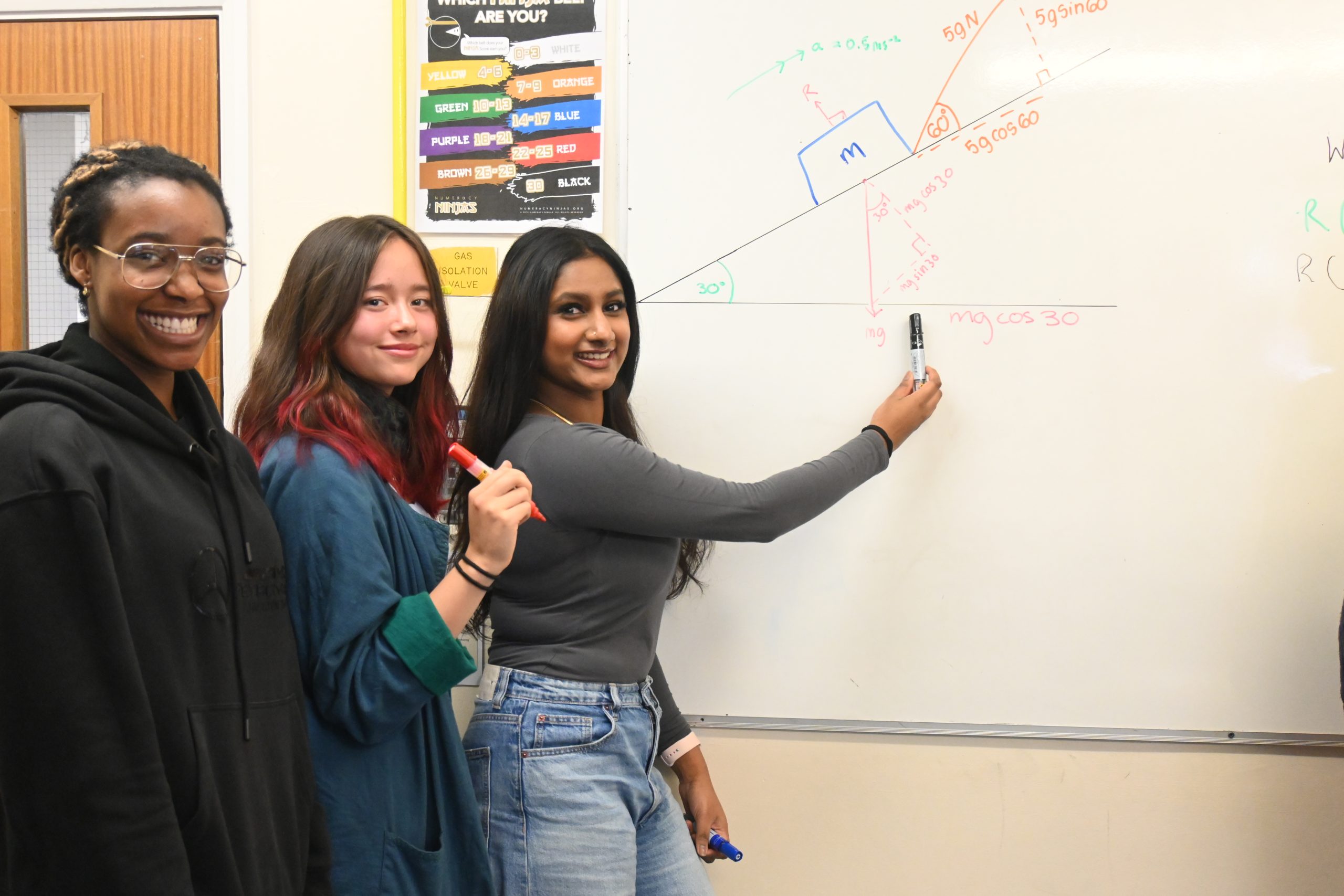
Maths is the most popular A-level in the UK – and for good reason. It goes with everything. Whether your strengths lie in the sciences, humanities, or creative subjects, Mathematics builds essential skills that enhance your performance across the board.
From solving real-world problems to analysing complex data, Maths trains you to think logically, work systematically, and tackle challenges with confidence. A-level Maths helps you to build a toolkit of transferable skills that are highly valued by universities and employers alike, including:
• Logical and analytical thinking
• Strong numeracy and problem-solving
• Confidence with abstract and complex concepts
• Independent working and perseverance
• Data interpretation and critical analysis
These are not just academic skills – they’re life skills, equipping you to thrive in a fast-changing
world.
HOW MATHS BOOSTS YOUR A-LEVEL OPTIONS
Maths is a subject that strengthens and supports a wide variety of A-level choices. It complements both STEM and humanities subjects, making it one of the most flexible and future-proof options you can take.
• Planning to study Biology or Chemistry?
Research shows that students who also take Maths or Further Maths achieve significantly higher grades across the board. It’s one of the most successful subject combinations for applying to Medicine, Dentistry, Veterinary Science, and Natural Sciences.
• Thinking about Economics, Psychology or Geography?
Maths enhances your ability to analyse data and understand statistical models, making your written work stronger and more evidence-based.
• Interested in Engineering or Computer Science?
Maths is essential – and Further Maths is highly recommended if you’re aiming for top university courses.
It’s also a great choice if you’re not 100% sure what you want to do next – because it keeps so many options open. And if you’re taking subjects like History or Art, Maths adds academic breadth and demonstrates rigorous thinking, which can strengthen your application to competitive universities.
WHERE CAN A-LEVEL MATHS TAKE YOU?
Maths is a facilitating subject, recognised by the Russell Group of universities as opening the widest range of degree options. It keeps your future flexible.
Popular University Courses include:
• Mathematics, Statistics and Data Science
• Medicine, Dentistry and Veterinary Science
• Physics, Chemistry and Natural Sciences
• Engineering (all disciplines)
• Computer Science and AI
• Architecture and Design
• Economics, Finance and Accounting
• Psychology, Geography and Environmental Science
Potential Careers include:
• Engineering and Scientific Research
• Software Development and AI
• Data Analytics and Cybersecurity
• Medicine and Healthcare Innovation
• Finance, Banking and Actuarial Science
• Architecture and Urban Planning
• Education, Law, and Public Policy
From robotics to climate modelling, AI to medical breakthroughs — Maths is crucial for innovation.
A-LEVEL MATHEMATICS
A-level Mathematics develops your knowledge of areas such as algebra, geometry, and statistics, while also advancing exciting new topics like calculus and infinite series. Together, these enhance your problem-solving ability and analytical thinking, making Maths one of the most valuable and respected subjects you can study.
A-level Mathematics is separated into Pure and Applied sections, with twice as much Pure Mathematics as Applied. The Applied section is split evenly into Mechanics and Statistics.
The A-level Mathematics qualification follows a three-paper model, with calculators allowed in all papers.
Paper 1
Pure Mathematics 1
(2 hours)
Paper 2
Pure Mathematics 2
(2 hours)
Paper 3
Statistics and Mechanics
(2 hours)
If you really enjoy Maths and want to explore it at a deeper level — especially if you’re considering a STEM degree — Further Maths is a fantastic choice. Introducing advanced concepts such as matrices and complex numbers, it explores how mathematical ideas interconnect in powerful ways, and develops the building blocks needed for degrees in engineering, material science, data science, and beyond.
For more information about how Maths and Further Maths can boost your A-level options or support a variety of university courses and career paths, please see the section on A-level Mathematics.
The A-level Further Mathematics qualification follows a four-paper model.
Paper 1
Core Pure
Mathematics 1
(1.5 hours)
Paper 2
Core Pure
Mathematics 2
(1.5 hours)
Paper 3
Further Pure
Mathematics 1
(1.5 hours)
Paper 4
Further
Mechanics 1
(1.5 hours)
MATHS OR FURTHER MATHS?
Mathematics gives you the tools to understand and shape the modern world. From the algorithms behind AI and social media to the models that drive climate science, medicine, and economics, Mathematics underpins almost every field of scientific study. It’s essential for subjects like physics, engineering, computer science, architecture, and economics, and it opens doors to a huge range of careers.
Further Mathematics takes this further, giving you a deeper understanding of advanced ideas such as matrices, complex numbers, and differential equations, and exploring how mathematical concepts interconnect in unexpected and powerful ways. These are the building blocks for degrees in engineering, material science, data science, physics, and beyond. It’s challenging, exciting, and highly valued if you’re considering a degree in STEM, especially by top tier universities.
The study of a Modern Foreign Language at A-level enables you to learn to communicate confidently and imaginatively in the chosen language. As well as developing your listening, speaking, reading and writing skills, you will acquire a deeper understanding of the culture of the countries and the people whose language you are studying. You will also develop your skills in independently researching a chosen topic and presenting your ideas and opinions in the spoken and written language.
Lessons are conducted in the target language and an important part of lesson time is the general conversation to encourage your spoken fluency. You will be encouraged to use the internet to watch television broadcasts and to read newspapers and magazines in the foreign language.
ENTRY REQUIREMENTS
A GCSE at grade 7-9 in the appropriate language is required to study Modern Foreign Languages at A-level.
LINKS WITH OTHER SUBJECTS
The study of Modern Foreign Languages can be combined with the full range of other subjects, since it promotes analytical, critical and communication skills. A range of topics will be explored, including Current Affairs and Current Issues, Geography, History, Art and Literature.
HIGHER EDUCATION AND CAREER OPPORTUNITIES
Advanced language skills open opportunities in higher education, not only in the study of foreign languages but also in obtaining grants and scholarships for studying abroad. An A-level in a foreign language extends your career possibilities in many fields including international business, law, banking and the travel industry. In MFL, you will acquire transferable skills that are in great demand by employers and universities, e.g. numeracy, literacy, ICT, research, presentation skills and the ability to work independently. An MFL can give breadth and perspective to your studies. The communication skills and confidence you acquire are an asset in any higher education course or career.
COURSE CONTENT
French and Spanish
For French please read also Spanish
Exam Board: AQA
Paper 1 – Listening, Reading and Writing
• Aspects of French-speaking society: current trends
• Aspects of French-speaking society: current issues
• Artistic culture in the French-speaking world
• Aspects of political life in the French or Spanish-speaking world
Paper 2 – Writing
• One text from the list set in the specification
For French: L’Etranger. Albert Camus.
For Spanish: La casa de Bernarda Alba. Federico Lorca.
• One film from the list set in the specification
For French. Un long dimanche de fiançailles. Jean-Pierre Jeunet.
For Spanish: Maria Llena eres de Gracia. Joshua Marston.
Paper 3 – Speaking
• Individual research project on a topic chosen by the student related to any French-speaking aspects
• One of four sub-themes i.e. ‘Aspects of French-speaking society: current trends’, ‘Aspects of French-speaking society: current issues’, ‘Artistic culture in the French-speaking world’, ‘Aspects of political life in the French-speaking world’.

This course offers a solid musical foundation, requiring performing, composing, listening and analytical skills in almost equal measure; there is considerable scope for the development of the individual’s special talents.
You will improve your skills in performing and composing in a range of styles. You will listen to a wide variety of music and develop a more informed appreciation of how and why it was written and/ or performed. Sixth Form Music students are encouraged to take some responsibility for music within the school, participating in activities and taking the lead whenever possible.
ENTRY REQUIREMENTS
A keen interest in creating and listening to different styles of music and a wish to broaden your experience and deepen your understanding of both live and recorded music.
The ability to perform on an instrument or sing to a standard that is roughly equivalent to a pass at Grade 6.
LINKS WITH OTHER SUBJECTS
Music links well with Modern Languages, English and History but can also be a good complement to studying science subjects.
HIGHER EDUCATION AND CAREER OPPORTUNITIES
Music can be studied at either a university or a conservatoire, which focuses on performing. The music industry is vast and there are a wealth of job opportunities – as a composer, with a record company, running arts festivals, as a music critic, in music therapy and in sound engineering, to name a few.
COURSE CONTENT
Exam Board: Eduqas
The course contains three units – Performing, Composing and Listening & Appraising. There are two pathways that candidates may choose from:
Option A:
Performing: 35%; minimum length 10-12 minutes
Composing: 25%; minimum length 4-6 minutes
Listening & Appraising: 40%
Option B:
Performing: 25%; minimum length 6-8 minutes
Composing: 35%; minimum length 8-10 minutes
Listening & Appraising: 40%
COURSE FORMAT
Unit 1: Performing
In this unit you will develop your skills as a performer. You can perform on any musical instrument or sing and will have the opportunity to take part in ensemble performances as well as solo performing.
Unit 2: Composition
Candidates complete two compositions, one to a brief set by Eduqas and one free composition
Unit 3: Listening and Appraising
Through studying a variety of genres, you will develop and improve your listening skills so that you can recognise different sounds and make judgements about performances. Knowledge and understanding of musical elements, contexts and language will be appraised through the context of three areas of study and you will be asked in the exam to apply knowledge to unfamiliar works.
Students follow three Areas of Study:
Areas of Study A is compulsory:
• The Western Classical Tradition, studying the development of the symphony from 1750 – 1900.
We then look at the following Areas of Study:
• Area of Study C: Musical theatre
• Area of Study E: Into the Twentieth Century
ASSESSMENT
Unit 1
Externally moderated by a visiting examiner.
Unit 2
Compositions are externally assessed.
Unit 3
Examination:
• Analysing and evaluating music
• Familiar and unfamiliar pieces
• Prescribed works
• Questions based on aural extracts
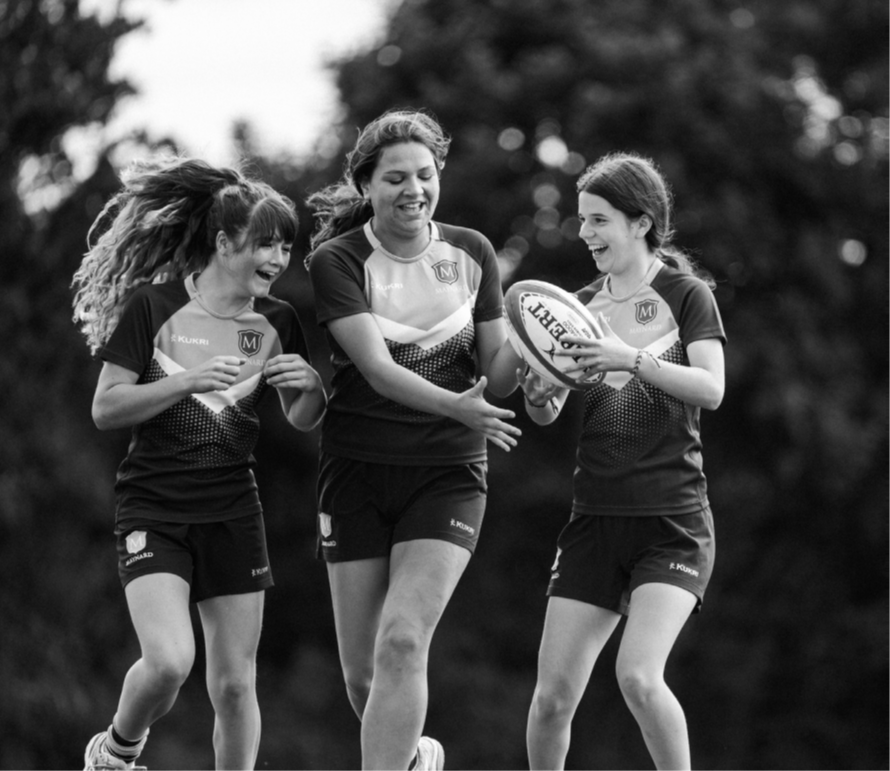
Studying Physical Education at A-level will give you a fantastic insight into the amazing world of sports performance. Not only will you have the chance to perform or coach a sport through the non-exam assessment component, you will also develop a wide ranging knowledge into the how and why of Physical Activity and Sport.
You will learn the reason why we do things, why some people outperform others-mentally and physically. You will also delve into ethical considerations behind the use of drugs and also the influence that modern technology is having on sport.
A-level PE involves the study of three theory components and the assessment in one practical component.
COURSE OUTLINE
Component 1: Physiological Factors Affecting Performance
A 2 hour written paper focusing on Applied Anatomy & Physiology, Exercise Physiology and Biomechanics.
(30% of total A-level)
Component 2: Psychological Factors Affecting Performance
A 1 hour paper focusing on Skill Acquisition and Sports Psychology.
(20% of total A-level)
Component 3: Socio-Cultural and Contemporary Issues
A 1 hour paper focusing on Sport, Society and Technological Influences.
(20% of total A-level)
Component 4: Performance within Physical Education
There are two parts to this component:
1. Sports Performance/Coaching in one activity.
2. Evaluating and Analysis of Performance for Improvement of Performance (EAPI). This component is internally assessed and externally moderated. It does not have to be the same sport or activity that was undertaken in part one, although it can be.
(30% of total A-level)
EXAMPLES OF PRACTICAL ACTIVITIES
(from approved DfE list)
• Athletics
• Badminton
• Basketball
• Dance
• Equestrian
• Hockey
• Netball
• Swimming
• Tennis
• OAA activities (Rowing, Kayaking, Rock Climbing)
FURTHER INFORMATION
Pupils with a genuine interest in studying sport will find the A-level PE course a wonderful platform from which to launch a career in the world of sports therapy, teaching, coaching, sports psychology, sports technology and not least sports science.
Many of our past students have gone on to study Sports Science, Medicine, Dentistry, Physiotherapy and Food Science amongst other subjects.

We follow the Edexcel A-level Physics course which is delivered through firstly introducing the Physics concepts and then applying them to real-life contexts.
Students are taught in a friendly group in well-equipped laboratories. They have many opportunities for hands-on practical work which enhances their scientific understanding of the Physics concepts. They work either individually or in small groups depending on the nature of the activity.
The girls quickly become confident and independent experimentalists, happy to try out new challenges.
ENTRY REQUIREMENTS
This A-level qualification builds on the knowledge, understanding and practical skills that students gained when studying GCSE Physics.
We require a minimum of a Grade 7 in GCSE Physics (or 7:7 in Combined Science) and a Grade 7 in Mathematics.
Students will also need to be able to communicate effectively. This involves being able to plan and carry out experiments, think logically about problems and present clearly structured explanations.
40% of the marks in A-level Physics examinations target Mathematics. Therefore, it is a requirement that students taking the A-level Physics are confident mathematicians. However, students are not required to study A-level Mathematics.
Mathematical aspects of the A-level course will encourage students to develop skills within the areas of:
• Arithmetic
• Numerical computation
• Handling data
• Algebra
• Graphs
• Geometry
• Trigonometry
ADDITIONAL COURSES
Students in the Lower Sixth may apply for a place on an EDT Insight into University course. The EDT Insight into University course is a comprehensive online course allowing students to experience STEM studies at university and the career opportunities that these subjects lead to. It provides information on university and student life, STEM projects and activities set by leading UK universities and global STEM companies, first-year undergraduate lectures, live interactive sessions with academics, admissions tutors, employers and current students. Whilst the Smallpeice Trust provides exciting programmes to promote engineering careers to young people through residential and day courses. On request, students will receive support in their applications for these courses from their Physics teachers.
Annually, our students have the opportunity to participate in the UK Space Design Competition, the Cityscape Architectural Design Competition, as well as Physics Olympiads. In 2025, our team reached the national finals of the UK Space Design Competition, which was hosted by Imperial College, and one of our students participated in the International Finals at the Kennedy Space Centre in Florida, representing the United Kingdom.
COURSE CONTENT
Paper 1:
• Mechanics
• Electric Circuits
• Further Mechanics
• Electric and Magnetic Fields
• Nuclear and Particle Physics
Assessment is 1 hour 45 minutes.
(30% of the total qualification)
Paper 2:
• Materials
• Waves and Particles – Nature of Light, Thermodynamics
• Nuclear Radiation Oscillations
• Gravitational Fields and Space
Assessment is 1 hour 45 minutes.
(30% of the total qualification)
Synoptic and practical paper:
This will include synoptic questions that may draw on any of the topics in this specification.
It will also include questions that assess conceptual and theoretical understanding of experimental methods that will draw on students’ experiences of the core practicals.
Assessment is 2 hours 30 minutes.
(40% of the total qualification)
SCIENCE PRACTICAL ENDORSEMENT
In addition to the A-level, students are assessed for the Science Practical Endorsement. This qualification is internally assessed and externally moderated by Pearson Edexcel. Students must show practical competency by completing practical tasks throughout the course. This qualification is accumulative. We will give students many opportunities to use relevant apparatus and techniques to develop and demonstrate specific practical skills throughout the two years.

Psychology is the scientific study of the mind and human behaviour. Psychologists observe and conduct experiments to find out more about the way people act and interact. They try to understand what motivates, challenges or changes us and use this understanding to help us tackle personal and social problems.
Psychologists can work in social care, mental health, education, business, research and sports. The AQA awarding body classes Psychology as a science A-level and it is accepted by all universities.
SO WHAT EXACTLY DO WE STUDY?
Below are examples of the sorts of questions that are asked during the course:
Developmental Psychology:
How do early experiences shape our futures?
How do we develop our gender identity?
Social Psychology:
Why do people obey other people?
How do social norms in society change?
Research Methods:
Learn how to carry out research by designing, carrying
out and analysing your own experiments, surveys,
interviews and observations.
Cognitive Psychology:
How can you improve your memory for exams?
Is eyewitness testimony reliable?
Approaches in Psychology:
What was Freud’s influence in psychology?
Is my future set by my biology?
Biological Psychology:
How does the brain process language and speech?
Do genes play a role in criminal behaviour?
Issues in Psychology:
How can you compare research from different countries?
What does research tell us about freewill?
Psychopathology:
What are the biological roots of OCD?
How does CBT work with depression?
HOW IS THE COURSE ASSESSED?
Examinations consist of short essays and structured questions. There is no coursework in the chosen specification.
HOW IS THE COURSE ORGANISED?
As with all subjects in The Maynard, the students are taught in small, friendly groups to enable all of them to participate confidently. Other skills acquired during the course include IT skills (using, for example, PowerPoint, Excel and Word), simple mathematical and statistical procedures, debating and researching your own ideas.
SUBJECT CONTENT
Compulsory content
• Social influence
• Memory
• Attachment
• Psychopathology
• Approaches in Psychology
• Biopsychology
• Research methods
• Issues and debates in psychology
Option 1 (one of these topics)
• Relationships
• Gender
• Cognition and development*
Option 2 (one of these topics)
• Schizophrenia*
• Eating behaviour
• Stress
Option 3 (one of these topics)
• Aggression
• Forensic psychology*
• Addiction
Religious Studies is an ideal option for those of you who enjoy exploring perplexing questions about life, the universe and everything: ‘Is there a God?’; ‘Why is there suffering?’; ‘Why should we live morally?’; ‘Is it ever right to end a life?’; ‘What happens when we die?’.
The Maynard Religious Studies course follows the OCR A-level Religious Studies specification (H573), which comprises three equally weighted areas of study: Philosophy of Religion, Religion and Ethics and Developments in Christian Thought.
This syllabus provides an opportunity to explore the rich heritage of western philosophical and ethical thought and to undertake a study of key concepts in Christianity. Students will encounter significant thinkers such as Plato, Aristotle, St Thomas Aquinas, Immanuel Kant, David Hume, J. S. Mill and Karl Marx, as well as prominent philosophers and theologians of the 20th century and the present day.
This qualification is designed to nurture the development of critical and reflective thinking with the aim of developing a greater comprehension and appreciation of religious beliefs and teachings, as well as the disciplines of ethics and philosophy of religion. Emphasis is placed on critical analysis and the construction of balanced, informed arguments within the context of religious, philosophical and ethical understanding.
ENTRY REQUIREMENTS
It is not necessary to have GCSE Religious Studies, or to be ‘religious’ to do this subject. What is necessary is an open, inquiring mind, plenty of enthusiasm and a willingness to engage in discussion and debate. All assessment is by essays written in the examinations so a good standard of written English is required and you will be expected to do a lot of reading to support your learning in class.
HIGHER EDUCATION AND CAREER OPPORTUNITIES
This course will enable you to develop a range of transferable skills which will be invaluable to you whatever you go on to do afterwards. Universities and employers welcome Religious Studies at A-level as a rigorous academic subject. It enables you to analyse and evaluate both your own arguments and those of others, whilst exposing you to a wide range of current issues and debates that will provide an excellent foundation for Higher Education. You might choose to pursue a degree course in Philosophy, Religious Studies or Theology; alternatively, Religious Studies provides a strong basis for a wide range of other subjects such as Law, Politics and Sociology as well as History and English. Many of our students choose RS to support their study of the sciences. Knowledge of ethics and, in particular, the study of the ethics of euthanasia would be of particular relevance and interest to those considering applying to read Medicine.
COURSE CONTENT
Exam Board: OCR
Philosophy of Religion
Ancient philosophical influences (Plato and Aristotle); arguments about the existence or non-existence of God; the nature and impact of religious experience; the challenge for religious belief of the problem of evil; the nature of the soul, mind and body; the possibility of life after death; ideas about the nature of God; issues in religious language.
Religion and Ethics
Normative ethical theories (Natural Law, Situation Ethics, Kantian Ethics and Utilitarianism); the application of ethical theory to contemporary issues of importance (sex and sexuality, business ethics, euthanasia); ethical language and thought; debates surrounding the significant ideas of conscience and free will.
Developments in Christian Thought
Augustine’s teaching on human nature; death and the afterlife; knowledge of God’s existence; the person of Jesus Christ; Christian moral principles; Christian moral action (Dietrich Bonhoeffer); religious pluralism and theology; religious pluralism and society; gender and society; gender and theology; the challenge of secularism; liberation theology and Marx.
The EPQ is a popular qualification that compliments your subject driven A-levels, giving you the opportunity to investigate a topic of your choice. You can either write a 5000 word report or produce an artefact (e.g. video, music CD, performance, artwork, website, book, fashion item, robot). Students use the EPQ as an opportunity to develop their passion in an area of interest, to be creative, to take an academic idea well beyond A-level or to immerse themselves in a subject that is not offered at A-level.
The EPQ demonstrates your ability to plan and organise a research project independently, obtain and analyse relevant data or evidence, use and develop skills to achieve planned outcomes and to evaluate those outcomes at the end of the project. You will be expected to spend 120 hours on the EPQ, including around ten hours of meetings with your supervisor. It is equivalent to an AS and carries up to 70 UCAS points if an A* is achieved.
COURSE STRUCTURE AND ASSESSMENT
(100% coursework)
Though the emphasis of the EPQ is on independent research and self-regulation, you will be assigned a supervisor who will advise and assist you at each stage of the project. In broad terms, the project will be organised and assessed like this:
• Initial planning meeting with your supervisor
• Submission of research topic and outline plan
• Mid project review with mentor
• End of project review with mentor
• Submission of research project and/or artefact
• Presentation of research project and/or artefact
The project should be 5000 words in length, or an equivalent artefact and written report combination. You might submit a 5000 word dissertation-style extended essay, but if you were conducting, for example, sociological research then an observation journal could count towards the word limit, a linguistic study might include a CD, an engineering project might include a model or construction, etc. All artefacts must be accompanied by a written report of at least 1500 words.
Universities and employers value the EPQ. The EPQ not only gives applicants something to write about in personal statements or talk about in interviews, but it is recognised in offers for many competitive courses:
“The University is supportive of the requirement to undertake an Extended Project… It is expected that some admissions tutors may make two alternative offers to those offering this qualification, one of which involves success in the Extended Project (for example either AAA at A-level or AAB at A-level plus Extended Project).” University of Bristol
Awarding Body: AQA; Duration: One year
SKILLS DEVELOPED
• Independent research and evidence analysis including visits to University Libraries
• Selection and analysis of data
• Time management
• Self-evaluation and reflection
• Giving a presentation on a complex subject
The Maynard School has been running the EPQ for a few years now and we have witnessed some very unique and fascinating projects. Each year around 50% of students take the Extended Project Qualification. Their results are stunning underlining the quality of our students’ work. In 2025, 100% students achieved A*/A grades with 86% of grades awarded at A*!
PAST STUDENTS HAVE PRODUCED THE FOLLOWING PROJECTS:
• To what extent was the financial crisis in France the main factor that led to the French Revolution in 1789?
• To what extent should Islamic law be recognised in the UK legal sphere?
• An exploration of Philip Taaffe in the context of African themes -producing a piece of Art work
• To what extent is the ‘Virtual Mirror Box’ therapy effective in treating Stroke patients?
• Do genetics and nature play a more important role in donor conceived families than the role of nurture?
• An investigation into the manner in which anthropomorphism is used on animals to make relating to them as characters easier for viewers
• To what extent was the ‘One child policy’, as applied in China, moral from a utilitarian perspective?
• How are the metaphysical poets’ relationships’ with God portrayed in their poems?
• Vaccination vs. Eradication: the UK fight against Bovine Tuberculosis?
• Is the ‘Virgin Queen’ an accurate representation of Elizabeth I?
• To what extent is social cost the main impact of the Vietnam War?
• To what extent has British Army involvement had an effect on the War on Terror?
• Cull or Cure? An investigation into preventing the spreading of bTB?
• To what extent would investing money in property be better than saving?
• To what extent has the manufacture and distribution of antiretroviral drugs impacted on the lives on HIV/AIDS sufferers in Sub-Saharan Africa?
• To what extent does Thalidomide affect the human body?
• To what extent does Confucianism impact on modern day Chinese Society?
• To what extent does HIV/AIDS impact on girls development in Africa?
• Is the brain hard-wired for hierarchy?
• How accurate is the biological approach in explaining Anorexia Nervosa?
• To what extent does the translation of literature affect readership with specific reference to 18th Century French texts?
• Is the preservation of languages the responsibility of society?
• How is our perception of historical events affected by literature which has been censored, with reference to George Orwell’s 1984 and Animal Farm?
• How have been GM crops been developed and what problems and solutions do they engender?
• To what extent did the external factors of the Victorian era influence Oscar Wilde’s collection of his major works?
• To what extent can the Shmallenberg virus be seen as a ticking timebomb?
• To what extent is the development of Alzheimer’s disease influenced by extrinsic risk factors?
• To what extent are current treatments effective at eliminating or severely reducing the frequency of seizures in children and adolescents with epilepsy?
Is there an interesting title not yet written? Sign up for the EPQ and write it!
Where next?